Lorsque vous serez prêt à vous aventurer hors des pistes balisées et à explorer le hors-piste, le choix des fixations de ski de randonnée devient une décision cruciale. Le marché du ski hors-piste ayant connu une croissance fulgurante en 2026 – en partie grâce à l'intégration du ski-alpinisme aux Jeux olympiques d'hiver – les fabricants ont inondé le marché d'une offre plus vaste que jamais. Comprendre les différences fondamentales entre les fixations à inserts et les fixations à cadre est essentiel pour trouver celles qui correspondent le mieux à votre style de ski et à vos objectifs.
Que sont les fixations de ski de randonnée alpine ?
Les fixations de ski de randonnée, souvent appelées fixations AT ou fixations à inserts ont une double fonction qui les distingue des fixations alpines traditionnelles. Ces fixations spécifiques permettent de déchausser le talon tout en gardant l'avant du ski en contact avec la chaussure, ce qui favorise une marche naturelle lors de la montée en peaux de phoque. Une fois arrivé à destination, au moment de la descente, il suffit de verrouiller le talon dans la fixation pour dévaler la pente avec contrôle et assurance.
L'innovation majeure réside dans leur polyvalence : vous pouvez gravir efficacement des milliers de mètres de dénivelé et profiter ensuite de la descente sans changer d'équipement. Cette fonctionnalité a révolutionné le ski hors-piste, le rendant plus accessible et agréable pour les skieurs de tous niveaux.
Comprendre les fixations techniques : légèreté et efficacité

Les fixations à inserts, initialement développées par Dynafit dans les années 1980, représentent la catégorie la plus populaire de fixations de ski de randonnée alpine en 2026. Après l'expiration du brevet de Dynafit au début des années 2000, le marché a connu une explosion d'innovations, et les fixations à inserts actuelles offrent des performances remarquables pour des poids incroyablement bas.
Comment fonctionnent les fixations techniques
Au lieu des ailerons traditionnels des fixations alpines, les fixations à inserts utilisent un système de goupilles. Deux goupilles métalliques situées à l'avant du pied se connectent directement à des inserts en acier intégrés à vos chaussures de ski de randonnée. Ce système place le point de pivot près du point de rotation naturel du pied, créant ainsi un mouvement de montée fluide et ergonomique, d'une sensation remarquablement naturelle.
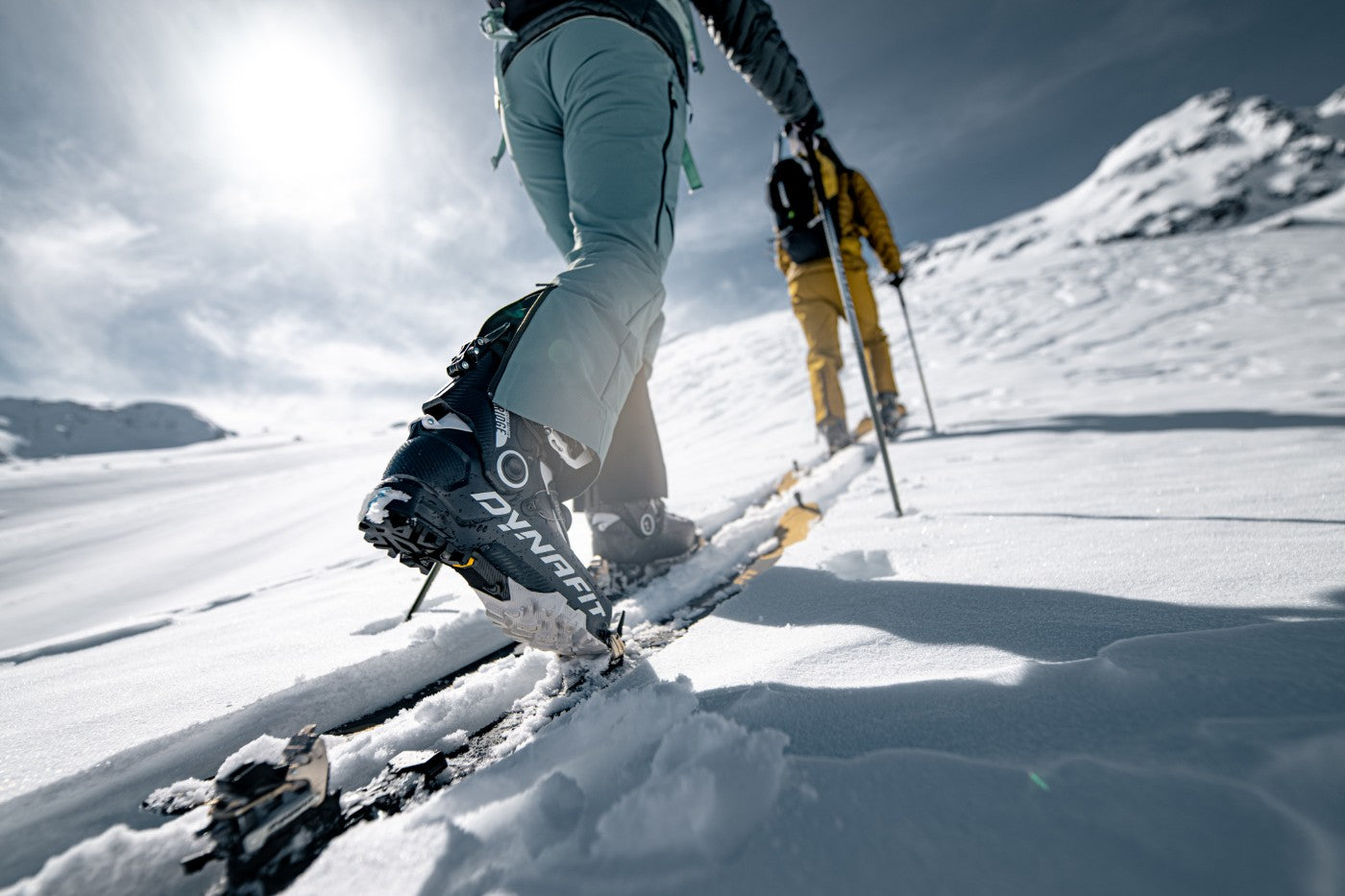
À la montée, votre botte reste fixée uniquement au niveau des orteils, permettant à votre talon de se soulever librement à chaque pas. Vous ne soulevez que le poids de votre chaussure et non celui de la fixation entière, ce qui réduit considérablement l'énergie nécessaire pour la montée. Pour la descente, vous chaussez le ski en bloquant la chaussure sur le ski grâce à des ergots supplémentaires (ou, dans certains cas, un mécanisme plus traditionnel).
Avantages des fixations techniques
L'atout principal des fixations à inserts réside dans leur poids plume. Les fixations modernes peuvent peser seulement 300 à 450 grammes chacune, et les modèles de compétition ultralégers descendent même sous la barre des 200 grammes. Cette réduction de poids se traduit directement par une meilleure efficacité en montée : sur une longue randonnée, vous dépenserez nettement moins d'énergie qu'avec des fixations plus lourdes.
Le mouvement de marche naturel permis par les fixations à technologie rend l'ascension des terrains escarpés et des dévers bien plus confortables. Grâce au pivotement autour de l'avant-pied, le mouvement imite votre foulée naturelle, réduisant ainsi la fatigue même lors de longues randonnées.
Un autre avantage important réside dans la transition fluide entre le mode randonnée et le mode ski. De nombreuses fixations à inserts permettent de changer de mode sans déchausser, ce qui représente un gain de temps précieux et réduit le risque de perdre du matériel sur les terrains escarpés ou exposés.
Exigences de compatibilité des bottes
Les fixations à inserts nécessitent des chaussures spécialement conçues avec des inserts métalliques à l'avant et à l'arrière. Toutes les chaussures de ski de randonnée alpine sont équipées de ces inserts et compatibles avec les fixations à inserts. En revanche, les chaussures de ski alpin classiques ne sont pas compatibles avec ce type de fixations ; il est donc indispensable d'investir dans des chaussures de ski de randonnée dédiées.
La plupart des fixations à inserts sont compatibles avec les semelles de chaussures de randonnée conformes à la norme ISO 9523, bien que certaines fonctionnent également avec des semelles de chaussures d'alpinisme légères non conformes. Il est essentiel de vérifier la compatibilité entre vos chaussures et les fixations choisies avant tout achat.
Catégories de fixations techniques
Les fixations de ski de randonnée de 2026 offrent un large éventail de performances. Parmi les modèles les plus légers, on trouve des fixations ultralégères conçues pour le ski de randonnée et les longues excursions où chaque gramme compte. Ces modèles privilégient l'efficacité en montée, au détriment parfois des performances en descente.
Les fixations de ski de milieu de gamme offrent un bon compromis entre légèreté et performance en descente, ce qui les rend idéales pour le ski de randonnée et les excursions à la journée. Elles intègrent souvent des fonctionnalités telles que des réglages de déclenchement, des cales de talon pour les montées raides et des freins intégrés.
Pour les freeriders les plus engagés, les fixations techniques renforcées intègrent des matériaux et des mécanismes supplémentaires afin d'améliorer le transfert de puissance et la réactivité en descente. Des modèles comme l'ATK Raider 13 EVO et diverses offres de Dynafit assurent d'excellentes performances en descente tout en conservant un poids raisonnable pour la montée.

Fixation de ski ATK Raider 13 EVO
Fixations à cadre : Performances en descente et capacités de randonnée
Les fixations à cadre représentent l'approche la plus traditionnelle du ski de randonnée alpine, adaptant essentiellement la technologie des fixations alpines à la pratique en hors-piste. Ces fixations se composent d'une butée et d'une talonnière reliées par un cadre ou un rail qui parcourt toute la longueur de la fixation.
Comment fonctionnent les fixations à cadre ?
Les fixations à cadre fonctionnent de la même manière que les fixations alpines classiques lorsqu'elles sont verrouillées pour le ski. L'ensemble de la fixation — butée, talonnière et cadre de liaison — repose sur une plateforme pivotante au niveau des orteils. Pour la montée, il suffit de déverrouiller un mécanisme qui permet à l'ensemble du cadre de se soulever à chaque pas, tandis que la butée reste ancrée au ski.
Grâce à cette conception, la fixation reste solidement attachée à votre chaussure lors des montées. Votre chaussure, votre fixation et votre ski se déplacent ensemble, le point de pivot se situant devant vos orteils et non au niveau de la plante naturelle de votre pied.
Avantages des fixations à cadre
Le principal atout des fixations à cadre réside dans leurs performances en descente. Conçues spécifiquement pour le ski alpin, elles offrent un excellent transfert de puissance, une grande stabilité et un contrôle optimal. Leur plateforme plus large et leur construction robuste inspirent confiance, notamment aux skieurs habitués des stations qui recherchent les mêmes sensations en hors-piste.
Les fixations à cadre sont certifiées DIN, ce qui signifie qu'elles répondent aux normes de sécurité internationales pour un déclenchement fiable en cas de chute. Pour de nombreux skieurs, notamment les débutants en ski hors-piste, cette certification est un gage de sérénité que les fixations à inserts n'offrent généralement pas.
Un autre avantage majeur réside dans la compatibilité avec les chaussures. Les fixations à plaque fonctionnent avec la plupart des types de bottes, y compris les bottes de ski alpin classiques, les chaussures de ski de randonnée avec inserts techniques et les bottes hybrides avec semelles GripWalk ou Walk to Ride. Cette polyvalence fait des fixations à cadre un excellent choix si vous souhaitez utiliser vos chaussures de ski alpin actuelles pour des sorties occasionnelles en hors-piste sans avoir à investir dans des chaussures de ski de randonnée spécifiques.
Les fixations à cadre sont généralement plus abordables que les fixations à inserts, leur prix étant souvent inférieur de plusieurs centaines de dollars à celui de modèles hybrides ou à inserts comparables. Pour une personne qui s'initie au ski hors-piste, les fixations à cadre constituent une option économique.
Inconvénients des fixations à cadre
Le poids est le principal inconvénient des fixations à cadre. Ces fixations pèsent généralement entre 1 600 et 3 000 grammes chacune, soit nettement plus que les fixations à inserts. Lors d'une longue randonnée, ce poids supplémentaire peut engendrer une fatigue accrue et une baisse de performance.
Le positionnement du point de pivot des fixations à cadre engendre une démarche moins naturelle. Situé en avant des orteils plutôt qu'à l'avant du pied, le pivot rend la foulée moins fluide, notamment sur les terrains escarpés et en traversée. À chaque pas, la fixation se soulève, créant une résistance de plus en plus perceptible lors des longues ascensions.
De plus, la fixation rigide du cadre réduit la flexibilité naturelle du ski, ce qui peut rendre la montée plus pénible et moins fluide par rapport à la liberté de mouvement offerte par les fixations à technologie.
L'essor des fixations hybrides en 2026

L'évolution des fixations de ski de randonnée a donné naissance à une troisième catégorie qui a connu un succès fulgurant : les fixations hybrides. Ces modèles innovants tentent de combiner les atouts des fixations à inserts et des fixations à plaque, offrant légèreté et performance en montée, ainsi qu'une excellente tenue en descente.
Comprendre la technologie hybride
Les fixations hybrides comme la Salomon Shift2 et l'ATK HY utilisent des inserts techniques pour la montée, permettant un ski de randonnée efficace avec une foulée naturelle. En descente, elles adoptent un système de fixation plus classique, de type alpin, offrant un transfert de puissance et un déclenchement supérieurs aux fixations à inserts purs.
Le Shift2, par exemple, est doté d'une butée avant intégrée pour le mode randonnée. Une fois prêt à skier, il suffit d'actionner un levier pour rabattre les ailettes sur la butée et la transformer en une butée de ski alpin certifiée. La talonnière fonctionne comme une talonnière de ski alpin traditionnelle, avec certification DIN et déclenchement précis.
Qui devrait envisager les fixations hybrides ?
Les fixations hybrides sont devenues la référence pour les skieurs qui partagent leur temps de manière relativement égale entre le ski en station et les sorties hors-piste. Elles sont également prisées des skieurs freeride adeptes du hors-piste qui privilégient une descente engagée et recherchent une confiance maximale sur les terrains techniques et escarpés.
Ces fixations sont idéales pour une utilisation polyvalente, permettant d'utiliser les mêmes skis aussi bien en station que lors de longues sorties hors-piste. Bien qu'elles soient plus lourdes que des fixations à inserts classiques (généralement entre 900 et 1 000 grammes par fixation pour la Shift2), elles restent nettement plus légères que des fixations à plaque.
Le compromis réside dans la complexité et le coût. Les fixations hybrides figurent parmi les options les plus onéreuses du marché, et leurs mécanismes exigent plus d'attention et d'entretien que les fixations à inserts ou à cadre plus simples. Les utilisateurs doivent être vigilants face à l'accumulation de neige et de glace, et le processus de transition est plus complexe qu'avec les fixations à inserts traditionnelles.
Éléments clés à prendre en compte lors du choix entre fixations techs et fixations à cadre
Priorité à la montée vs. à la descente
La question fondamentale à se poser est la suivante : quel pourcentage de votre temps consacrerez-vous à la montée par rapport à la descente, et quel aspect valorisez-vous le plus ?
Si vous prévoyez de longues randonnées avec trois heures de montée pour trente minutes de descente, les fixations à inserts sont le choix idéal. Le gain de poids et le mouvement naturel qu'elles offrent rendront ces longues approches bien plus agréables. À l'inverse, si votre principal objectif est d'accéder à des terrains escarpés et techniques pour un ski engagé et que l'effort à la montée ne vous dérange pas, les fixations à plaque ou hybrides offrent des performances supérieures en descente.
Votre équipement existant
Tenez compte de votre équipement actuel. Si vous possédez déjà de bonnes chaussures de ski alpin et souhaitez débuter le ski de randonnée sans investissement supplémentaire important, les fixations à cadre vous permettent d'utiliser votre matériel actuel. En revanche, si vous construisez votre équipement de A à Z ou si vous pratiquez régulièrement le ski hors-piste, investir dans des chaussures de randonnée et des fixations à inserts vous offrira une meilleure expérience sur le long terme.
Style de ski et terrain
Les skieurs agressifs qui enchaînent les sauts, les pentes raides et les descentes rapides dans des conditions variables privilégient souvent la sécurité et la puissance des fixations à cadre ou des modèles hybrides haut de gamme. Le déclenchement plus prévisible et la construction robuste offrent une confiance accrue lors des descentes à la limite.
Les skieurs privilégiant les longues distances, l'ascension de sommets isolés ou le ski-alpinisme tireront le meilleur parti des fixations techniques légères. Le gain de poids devient de plus en plus significatif sur les randonnées dépassant 600 à 900 mètres de dénivelé.
Considérations budgétaires
Les fixations à cadre représentent l'option la plus abordable, souvent disponibles entre 300 et 400 dollars. Les fixations tech varient d'environ 400 dollars pour les modèles de base à plus de 700 dollars pour les options haut de gamme dotées de fonctionnalités avancées. Les fixations hybrides sont plus onéreuses, généralement entre 600 et 800 dollars, voire plus.
N'oubliez pas que le choix de vos fixations influence l'ensemble de votre équipement. Les fixations à inserts nécessitent des chaussures de ski de randonnée spécifiques (comptez 400 à 800 $ supplémentaires), tandis que les fixations à plaque peuvent être compatibles avec des chaussures que vous possédez déjà.
Considérations relatives à la sécurité et à la libération
Comprendre le mécanisme de déclenchement des fixations est essentiel pour la sécurité en hors-piste. Les fixations à cadre sont certifiées DIN, ce qui signifie qu'elles répondent aux normes internationales en matière de force de déclenchement et de tests. Correctement réglées par un technicien agréé, elles se déclencheront de manière prévisible en cas de chute.
Les fixations de ski de randonnée traditionnelles ne sont généralement pas certifiées DIN. Bien qu'elles possèdent un mécanisme de déclenchement, leurs caractéristiques diffèrent de celles des fixations alpines. La butée avant a généralement une valeur de déclenchement fixe (équivalente à une valeur DIN de 10 à 12 environ), tandis que la talonnière offre une certaine marge de réglage. Cela peut rendre le réglage optimal plus difficile, notamment pour les skieurs légers ou ceux dont le poids est très variable.
Certaines fixations de ski de randonnée récentes ont obtenu la certification TÜV, une norme européenne indépendante en matière de sécurité des fixations. Des fixations comme la Fritschi Tecton et divers modèles Marker répondent à ces normes, offrant des caractéristiques de déclenchement plus proches de celles des fixations alpines tout en conservant l'efficacité des fixations à inserts.
Quel que soit le type de fixation, il est essentiel de faire monter et régler vos fixations par un technicien de ski certifié qui comprend les exigences spécifiques des fixations de randonnée.
Le paysage du marché en 2026
Le marché des fixations de ski de randonnée alpine est plus compétitif et innovant que jamais en 2026. Voici quelques tendances qui façonnent l'offre actuelle :
Optimisation du poids : Les fabricants repoussent sans cesse les limites de la conception légère. La fixation ATK Raider 13 EVO, par exemple, ne pèse que 370 grammes tout en intégrant un réglage du déclenchement des orteils, une caractéristique inédite pour une fixation à inserts.
Freins améliorés : Les systèmes de freinage automatiques ont remédié à l’un des points faibles historiques des fixations à inserts. Des modèles comme l’ATK Raider EVO sont équipés de freins qui s’enclenchent de manière fiable sans alourdir significativement l’ensemble.
Enfilage facilité : chausser des fixations techniques dans des conditions difficiles a toujours été une source de frustration. Les nouveaux modèles sont dotés de plateformes d’enfilage plus larges et de mécanismes intuitifs qui facilitent l’entrée en neige, même en cas d’accumulation de neige.
Priorité à la durabilité : les marques utilisent davantage de composants métalliques et une construction renforcée dans les modèles orientés freeride, répondant ainsi aux préoccupations concernant la casse des pièces en plastique en cas d’utilisation intensive.
Évolution hybride : Les fixations hybrides de deuxième génération comme la Shift2 ont perfectionné les modèles originaux, améliorant la durabilité, le transfert de puissance et la fiabilité du freinage grâce à des années de retours d’expérience concrets.
Prendre votre décision
Le choix entre fixations à inserts et fixations à platine dépend avant tout de vos besoins, de vos objectifs et de votre style de ski. Voici un guide de décision simplifié :
Choisissez des fixations tech si :
- La réduction du poids et l'efficacité en montée sont prioritaires
- Vous prévoyez de longs circuits ou des excursions de plusieurs jours.
- Vous êtes prêt à investir dans des bottes de ransonnée dédiées
- Vous êtes à l'aise avec les différentes caractéristiques de libération
- Vous souhaitez un mouvement de croisière le plus naturel possible.
Choisissez les fixations à cadre si :
- Vous débutez en ski hors-piste et recherchez des performances de descente familières
- Vous souhaitez utiliser vos chaussures de ski actuelles.
- Vous privilégiez le ski en descente à l'efficacité en montée.
- Vous accordez de l'importance à la certification DIN et à une mise en service prévisible
- Le budget est une préoccupation majeure.
- Vos circuits sont relativement courts (moins de 1 500 pieds de dénivelé).
Choisissez une fixation hybride si :
- Vous partagez votre temps équitablement entre la station et l'arrière-pays
- Vous voulez une seule configuration capable de tout faire.
- La performance en descente est cruciale, mais le poids compte.
- Vous êtes prêt à investir dans du matériel haut de gamme
- Vous skiez de manière agressive en hors-piste
Au-delà des fixations: Créer votre configuration complète
N'oubliez pas que les fixations ne sont qu'un élément de votre équipement de ski de randonnée. Votre choix doit s'inscrire dans le cadre de vos objectifs globaux :
Adaptez le poids de vos fixations à celui de vos skis. Les fixations ultralégères sont idéales pour les skis de randonnée légers, tandis que les fixations plus robustes conviennent mieux aux skis freeride plus imposants. Un mauvais choix de fixations peut entraîner un déséquilibre et des performances moindres.
Assurez-vous de la compatibilité de vos bottes, non seulement au niveau des fixations techniques, mais aussi en termes de flexibilité et de rigidité. Une chaussure rigide et performante associée à une fixation technique minimaliste ne vous permettra pas d'exploiter pleinement son potentiel.
Pensez à votre équipement de randonnée complet, incluant peaux de phoque, bâtons, matériel de sécurité et vêtements. Le gain de poids réalisé sur les fixations pourrait être annulé par le poids superflu de votre sac à dos.
Conclusion : La fixation idéale pour vos aventures
Le débat entre fixations à inserts et fixations à cadre n'a pas de solution universelle : il existe seulement la meilleure option pour chaque situation. Les fixations à cadre restent un choix judicieux pour les débutants et les skieurs privilégiant les pistes, offrant des performances éprouvées et un prix abordable. Les fixations à inserts dominent le marché des skieurs de randonnée confirmés, offrant une efficacité inégalée pour ceux qui parcourent de longues distances. Enfin, les fixations hybrides se sont taillé une place de choix pour les skieurs qui refusent tout compromis entre performance en montée et en descente.
Au moment de choisir votre équipement, réfléchissez honnêtement à l'utilisation que vous en ferez. Nombreux sont les skieurs qui surestiment le temps qu'ils passeront à skier en station avec leur matériel de randonnée, ou qui sous-estiment l'impact du poids des fixations à cadre sur leur expérience lors de longues randonnées.
La bonne nouvelle, c'est que le marché des fixations de ski de randonnée alpine en 2026 propose des options exceptionnelles dans toutes les catégories. Que vous fassiez vos premiers pas en hors-piste ou que vous cherchiez à améliorer votre équipement actuel, il existe une fixation conçue précisément pour votre style de ski.
Prêt à trouver les fixations de ski de randonnée alpine parfaites pour vos aventures en pleine nature ? Explorez notre sélection complète de fixations techniques et hybrides et découvrez la configuration qui vous permettra d'atteindre votre prochain objectif en montagne.