You've decided an airbag is worth it. Now you have to pick a system, and the two options look more similar than they are. One inflates with a fan, the other with compressed gas. Every review will tell you that much. What almost none of them tell you is what happens when the bag goes off and you need it ready again, or what happens when you try to take it on a plane to or from Calgary. Those two answers decide the purchase for most people in Canada, so this guide leads with them. We stock both systems in Canmore, so we have no reason to steer you.
How does an electric avalanche airbag work?
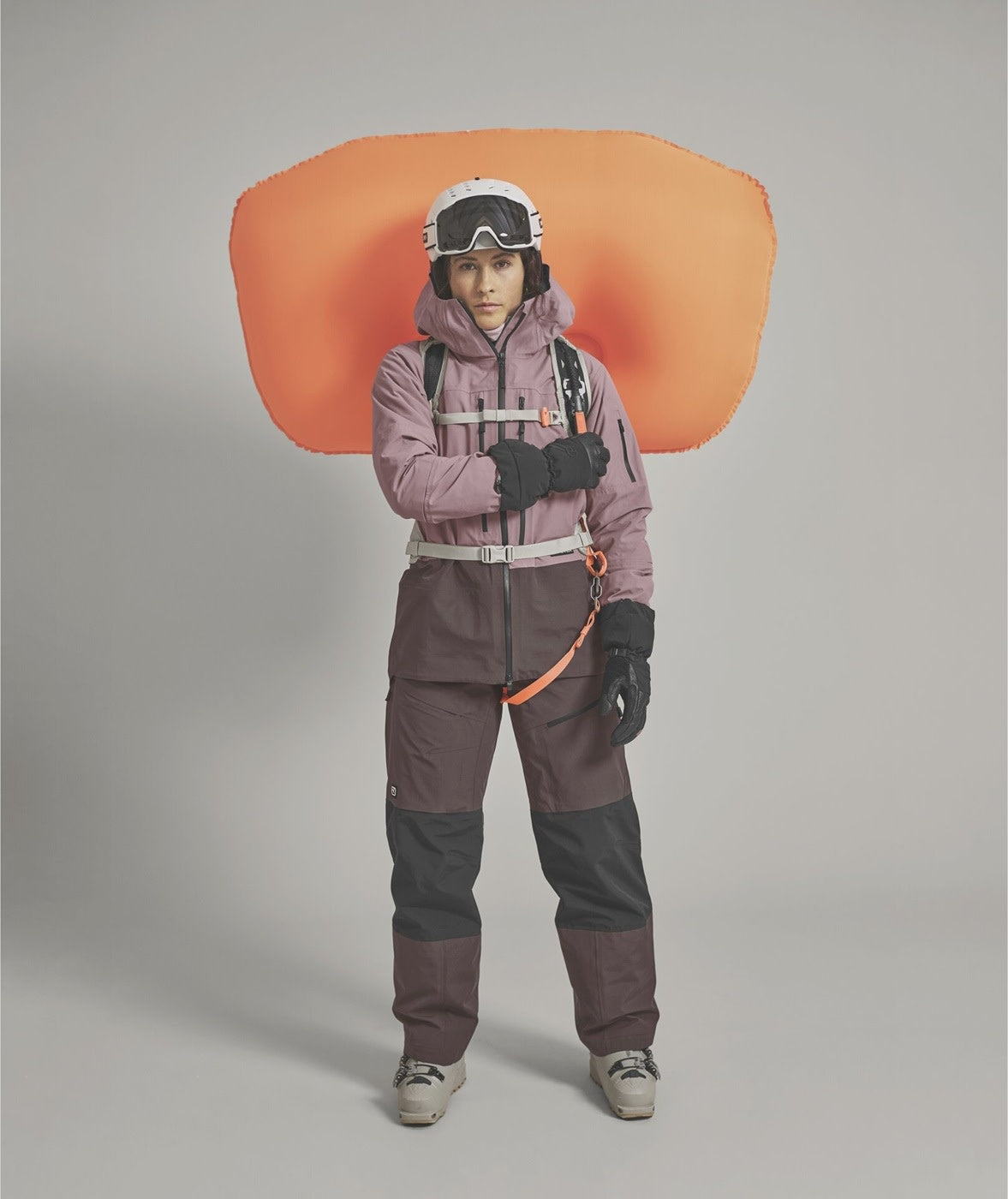
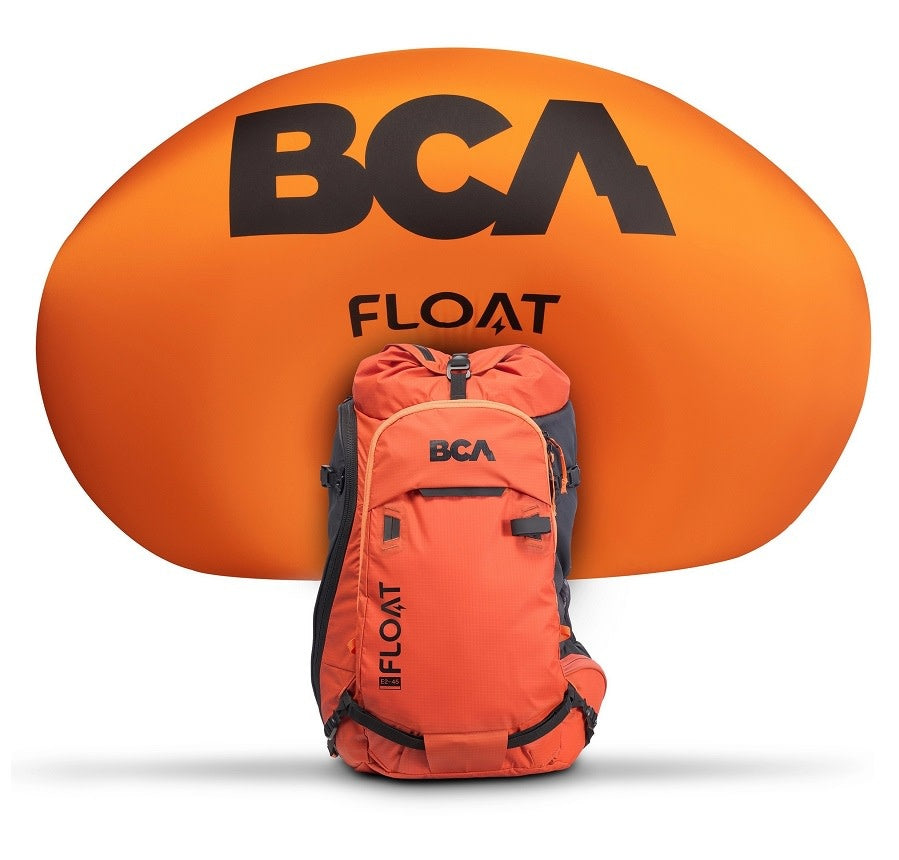
An electric avalanche airbag uses a battery or supercapacitor to drive a high-speed fan. Pull the handle and the fan pushes ambient air into the balloon, which means the air it inflates with is simply the air around you. Nothing is consumed, so once it is recharged the system is ready again.
You will also see these called fan powered avalanche airbags, electronic airbags, or by their platform names. The systems we carry are the Alpride E2 in the BCA Float E2 packs and the LiTRIC platform in the Ortovox Avabag Litric. Both use supercapacitors rather than a conventional lithium battery, which is deliberate: supercapacitors hold their charge behaviour better in deep cold, and cold mornings in the Bow Valley are not an edge case.
The practical consequences matter more than the engineering:
- Multiple deployments per charge. You are not out of commission after one pull.
- Practice costs nothing. This is the quiet advantage, and we will come back to it.
- Nothing to buy again. No cylinder to source, no refill to arrange mid-season.
- Charging is a habit. It goes on the pre-season checklist alongside your transceiver batteries.
How does a cartridge avalanche airbag work?
A cartridge airbag releases compressed gas from a pressurised cylinder into the balloon. The cylinder is a consumable. Once it has discharged, the pack will not inflate again until you replace or refill it.
Cartridge systems have been in the field far longer, which shows in the price and the weight. For the same volume they generally weigh less than an electric pack, because a cylinder weighs less than a fan, a housing and a supercapacitor. We carry the Mammut Removable Airbag 3.0 system, which can move between compatible Mammut packs, and the BCA Float 2.0, along with replacement cylinders and refill kits.
The trade is straightforward. You pay less to get into the sport and more every time the bag goes off.
Electric vs cartridge, side by side
| Criterion | Electric (fan) | Cartridge (compressed gas) |
|---|---|---|
| Inflation source | Fan draws in ambient air | Pressurised cylinder |
| Deployments before reset | Multiple per charge | One per cylinder |
| Cost to reset | Nothing, just recharge | About $40 per refill and $249.99 to $289.99 if you need a new cylinder |
| Practice deployments | Free, so people do them | Cost money, so most people skip them |
| Flying in North America | Simpler, airline approval still required | Cylinder must be empty, refill at destination |
| Weight for the same volume | Generally heavier | Generally lighter |
| Entry price at Vertical Addiction | $1,750 | $749 |
| Moves between packs | Depends on the platform | Yes on Mammut Removable Airbag 3.0 |
What does it cost to keep each system running?
A cartridge pack costs money every time the bag inflates. Budget $249.99 to $289.99 for a cylinder and roughly $40 for each refill after that. An electric pack costs nothing beyond the charge.
| Model | System | Volume | Price (CAD) | Cost to reset |
|---|---|---|---|---|
| BCA Float 42 2.0 | Cartridge | 42 L | $749 | About $40 per refill and $249.99 if you need a new cylinder |
| Mammut Pro 35 Removable Airbag 3.0 | Cartridge | 35 L | $1,149 | About $40 per refill (including the seal kit) and $289.99 if you need a new cylinder, including the seal kit |
| Ortovox Avabag Litric Zero 27 | Electric | 27 L | $1,750 | Recharge, no consumable cost |
| BCA Float E2-35 | Electric | 35 L | $1,899 | Recharge, no consumable cost |
| BCA Float E2 45L | Electric | 45 L | $1,999 | Recharge, no consumable cost |
Prices current as of publication.
Here is the part that gets overlooked. The reset cost does not just affect your wallet after an avalanche, it affects whether you ever practice. The largest study of real avalanche accidents found that one in five airbags did not inflate, and sixty percent of those failures came down to the user not deploying the pack. We cover that in detail in our guide to whether avalanche airbags actually work.
A pack you have never pulled is a pack you might not pull when it counts. If a practice deployment costs $40 and a trip to get the cylinder refilled, most people will decide to do it next season, every season. That is the strongest argument for electric, and it has nothing to do with the technology.
Can you fly with an avalanche airbag?
Yes, but a cartridge changes everything. The International Air Transport Association classifies compressed gas cartridges as dangerous goods and permits one airbag and one cartridge per person under specific conditions, with the airline's prior approval. North America is the exception: manufacturers state that filled cartridges are not permitted on flights into or within the United States and Canada.
What the IATA allowance actually requires
For flights outside North America, the conditions are consistent across manufacturers. One airbag and one cartridge per person. The cartridge has to travel inside the pack's designated compartment rather than separately, and it must not be screwed into the system. You need to contact the airline before booking, send them the cartridge data sheet and the relevant IATA table extract, and carry printed copies with the pack. And the important caveat: even with IATA approval, any airline is entitled to refuse your cartridge at the counter.
The North America exception
This is the one that catches Canadian skiers. Ortovox states plainly that filled pressurised cartridges are not permitted on aircraft travelling to the USA or Canada, and recommends flying without one and sourcing a cartridge locally. Other manufacturers say the same, with the requirement that the cylinder be completely empty.
Read that again if you are planning a trip. It applies to domestic flights too. Flying your cartridge pack from Calgary to Revelstoke, or out to a heli trip, means the cylinder travels empty and you need a plan to fill it at the other end. If you are heading somewhere without a dealer who can refill your specific cartridge, you do not have a functioning airbag for that trip.
Some systems are built with exactly this in mind. Mammut's refillable aluminium cartridge is designed to be flown empty and refilled at the destination, which is a meaningful advantage over a non-refillable cylinder if you travel.
Flying with an electric pack
Simpler, not automatic. There is no compressed gas, which removes the dangerous goods question entirely, but you still need the airline's approval and you still need to check their rules on batteries and supercapacitors. Carry the manufacturer's documentation. The difference is that you arrive with a working airbag rather than an empty cylinder and a problem to solve.
Whichever system you choose, check your airline's own dangerous goods page before you book, not at the airport. Policies differ between carriers and they change.
So which one should you buy?
Electric if you fly to your skiing or want to practice without counting the cost. Cartridge if budget is the deciding factor and you ski close to home.
- You fly to ski. Electric. The North America cartridge rule alone settles it, and it applies to domestic flights as well as trips abroad.
- You tour out of Canmore, Lake Louise or Kananaskis and drive to the trailhead. Either works. A cartridge pack at $749 is real value, and you are never far from a dealer.
- You want to practice properly. Electric. Free deployments are the difference between rehearsing and intending to rehearse.
- You are counting grams on long ski mountaineering days. Cartridge, generally, for the same volume.
- You want one system across two packs. Mammut Removable Airbag 3.0 moves between compatible packs, or the Ortovox Litric interchangeable zip-on system lets you swap different pack volumes and styles onto a single electronic avalanche airbag base using a hidden zipper.
- Budget is the constraint. A cartridge pack you actually carry beats an electric pack you cannot afford. Budget one refill a year and use it.
Frequently asked questions about electric and cartridge airbags
Is an electric avalanche airbag better than a cartridge one?
Neither is safer in an avalanche. Both inflate a balloon of roughly the same volume. The differences are all in ownership: what a reset costs, whether you can fly with it, and how much it weighs. Pick based on how you ski, not on which technology sounds more advanced.
How many times can an electric airbag deploy on one charge?
More than once, which is the point, but the exact number depends on the system and the conditions. Check the manufacturer's figure for the specific pack and treat cold weather as a factor. If you have deployed it, recharge it before the next tour.
Where do I get an avalanche airbag cartridge refilled?
Through a dealer who handles your specific cartridge. Not every cylinder is refillable, and the ones that are need the correct fill and a fresh seal. Ask before you buy, especially if you travel. Come talk to us about what we can handle in Canmore.
Can I bring a full cartridge on a flight within Canada?
No. Manufacturers state that filled compressed gas cartridges are not permitted on flights into or within Canada and the United States. The cylinder travels empty and gets refilled at your destination.
Do electric airbags work in deep cold?
The supercapacitor systems we carry were designed with cold performance in mind, which is why they use capacitors rather than conventional lithium batteries. Check the manufacturer's rated operating temperature for your specific pack and store it charged.
Where to start?
If you are still deciding whether an airbag belongs in your kit at all, start with our guide to whether avalanche airbags actually work. It covers what the research shows and, just as usefully, where an airbag will not help you.
If you have decided and you are choosing between systems, come into the shop. We will put both on you loaded, show you where the handle sits with your jacket on, and talk through how you actually ski before you spend $750 or $1,900.
To shop the full current selection:
- Avalanche airbags: electric and cartridge packs, 27L to 45L, plus cylinders and refill kits.
- Avalanche beacons + transceivers: the device that finds you if the airbag doesn't keep you up.
- Probes + shovels: the other two thirds of a rescue kit.
- Avalanche safety: the complete selection, including snow study tools and radios.