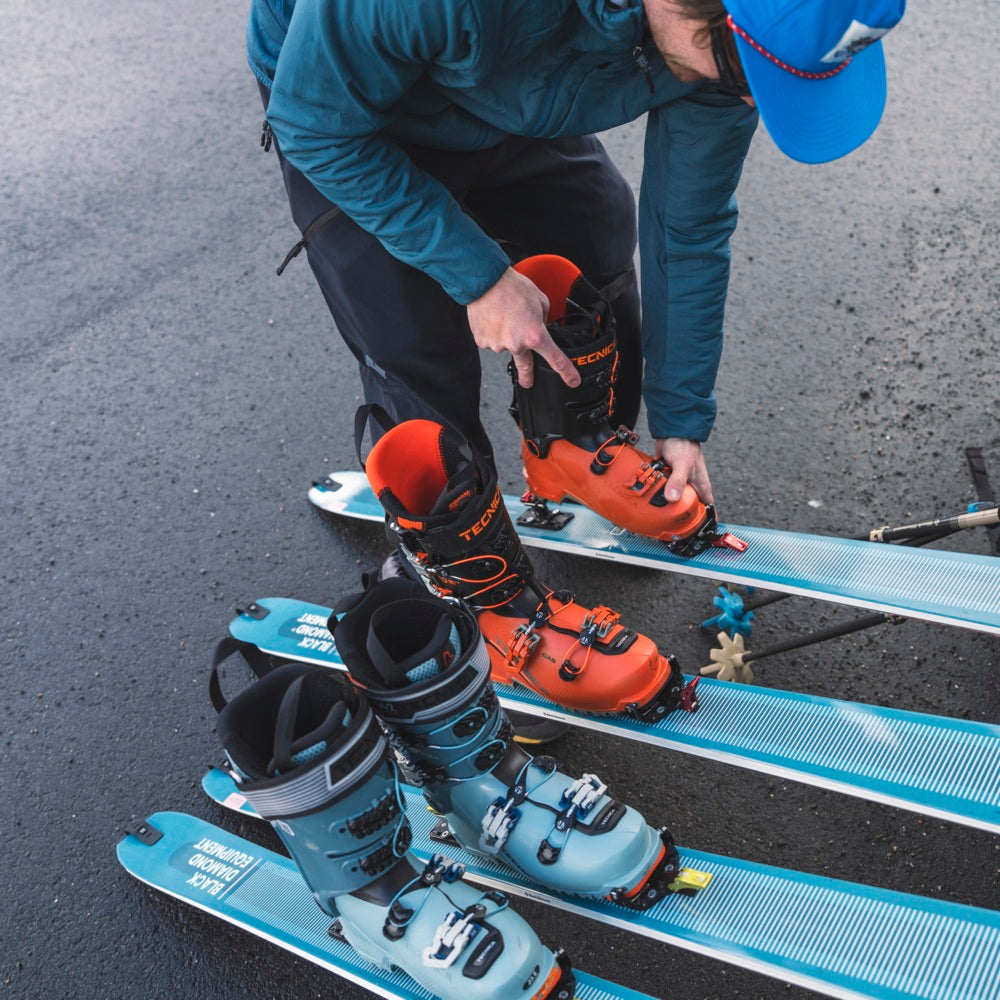
We’re a small, premium shop—not a chain. Every customer gets tailored advice, curated gear, and real service from mountain-savvy staff who know your sport.
Real Expertise
We live the mountain life—so our advice comes from real experience, not sales scripts.
Curated Gear
Every item is handpicked for quality and performance—no bulk, no fluff.
Small Shop, Big Heart
We’re local, independent, and here for the community. Your support matters.
You're looking at a $1,900 backpack and wondering whether it does anything. It's a fair question, and the honest answer is more interesting than either the marketing or the internet arguments suggest. Avalanche airbags work, and the largest study of real accidents found they roughly halve mortality. But the size of that effect is smaller than most people assume, and it collapses entirely in situations that are common in the Canadian Rockies. We sell these packs in Canmore and we'd rather you bought one understanding exactly what it does. This guide covers the evidence, the limits, and the single biggest reason airbags fail.
Key takeaways
The largest study of real avalanche accidents found inflated airbags cut mortality from 22% to 11%, an absolute reduction of 11 percentage points, or roughly half the risk.
Airbags work by preventing deep burial, not by protecting you during the slide. Adjusted risk of critical burial drops from 47% to 20% when the bag inflates.
One in five airbags in that study did not inflate. Sixty percent of those failures came down to the user not deploying the pack, not to mechanical fault.
An airbag does nothing for trauma from trees and rocks, nothing for terrain traps, and nothing to help anyone locate you once you're buried.
Airbag packs at Vertical Addiction run $749 to $1,999 CAD. Cartridge systems occupy the lower half, electric systems the upper, and electric packs cost nothing to reset, which is why people actually practice with them.
Do avalanche airbags work?
Yes. The largest study of real avalanche accidents found that victims wearing an inflated airbag died 11% of the time, compared with 22% for those without. That is an absolute reduction of 11 percentage points. The benefit is real, smaller than earlier estimates suggested, and entirely dependent on the bag actually inflating.
That figure comes from a 2014 study published in the medical journal Resuscitation, led by Pascal Haegeli of Simon Fraser University. His team analysed 245 avalanche accidents between 1994 and 2012 across Canada, the United States, Austria, France, Norway, Slovakia and Switzerland, adjusting for avalanche size, injuries and burial depth. It remains the reference point for this question, and it's worth knowing as a Canadian skier that the researcher behind it is based in British Columbia. Canadian accidents are in the dataset.
Read that mortality number carefully. It does not mean 89% of people in serious avalanches survive because of an airbag. It means that among people caught in avalanches large enough to bury or kill them, the death rate roughly halved. Most people caught in avalanches survive with or without one. The airbag moves the odds in the cases that go badly.
How does an avalanche airbag work?
Pulling the handle inflates a balloon of roughly 150 litres. Moving avalanche debris sorts itself by size, pushing larger objects toward the surface, the same reason the big nuts end up on top of the jar. The inflated bag makes you a larger object, so you're more likely to finish on or near the surface instead of underneath it.
This matters because of what actually kills people in avalanches. Asphyxia is the leading cause of death, and burial depth is the strongest single predictor of survival. An airbag doesn't protect you during the slide. It changes where you end up when the snow stops.
The study puts numbers on that mechanism. Adjusted risk of critical burial, meaning your head finishes under the snow, was 47% for people whose airbags didn't inflate and 20% for people whose did. Once someone is critically buried, adjusted mortality is 44%. For those not critically buried, it drops to 3%. That gap between 44% and 3% is the entire argument for wearing one.
Avalanche airbag outcomes, adjusted results from 245 real accidents
Outcome (adjusted)
Airbag did not inflate
Airbag inflated
Risk of critical burial
47%
20%
Mortality
22%
11%
Mortality if critically buried
44%
Mortality if not critically buried
3%
Source: Haegeli et al., Resuscitation 85 (2014), pages 1197 to 1203.
Where an avalanche airbag will not help you
An airbag solves exactly one problem, burial, and does nothing about the others. In Rockies terrain, where a lot of touring happens in and above trees and over terrain traps, those others come up often enough to matter.
Trauma. An inflated balloon offers no impact protection. Carried into trees, over rock bands or off a cliff, the airbag is irrelevant. This is not a minor caveat in the Bow Valley, where treed touring is the norm.
Terrain traps. Gullies, creek beds and flat benches below a slope create deep deposition zones. Enough snow piles up that flotation stops mattering.
Getting found. If you're buried, the airbag contributes nothing to the search. Your partners find you with a transceiver, a probe and a shovel, or they don't find you in time.
Decision-making. There's a real concern among guides and researchers that wearing an airbag nudges people into terrain they'd otherwise avoid. No safety device survives that trade.
Why do one in five airbags fail to inflate?
Across the 245 accidents studied, 20% of airbags did not inflate. Sixty percent of those failures were attributed to deployment failure by the user, not to mechanical fault. People didn't pull the handle, or couldn't reach it.
That finding reframes the purchase. The pack isn't the safety device on its own. The pack plus a person who has rehearsed pulling the handle is the safety device. The most common mistake we see at the counter is a customer who has owned an airbag for two seasons and has never once deployed it, often because it's a cartridge system and a practice pull costs money to reset.
Deploy it at least once before the season starts, wearing the layers you actually ski in.
Check handle position every time you put the pack on. A jacket, chest strap or camera harness will bury it.
Do the leg strap up. An unsecured pack can be torn off you in a slide.
Favour a system you'll actually practice with. This is the strongest practical argument for electric: with no cartridge to refill, rehearsing is free.
What does an avalanche airbag cost in Canada?
Airbag packs at Vertical Addiction run $749 to $1,999 CAD. Cartridge systems sit in the lower half of that range and electric systems in the upper. The purchase price isn't the whole picture, because cartridge packs carry a reset cost every time the bag goes off.
Avalanche airbag packs in stock, prices and cost to reset
Model
System
Volume
Price (CAD)
Cost to reset
BCA Float 42 2.0
Cartridge
42 L
$749
$249.99 cylinder, then $40.00 per refill including the seal
Mammut Pro 35 Removable Airbag 3.0
Cartridge
35 L
$1,149
$289.99 cartridge, then $40.00 per refill including the seal kit
Ortovox Avabag Litric Zero 27
Electric
27 L
$1,750
Recharge, no consumable cost
BCA Float E2-35
Electric
35 L
$1,899
Recharge, no consumable cost
BCA Float E2 45L
Electric
45 L
$1,999
Recharge, no consumable cost
Prices current as of publication.
Run the maths over a few seasons before you decide. A BCA Float 42 2.0 at $749, plus a spare cylinder at $249.99 so an empty cartridge never grounds you mid-season, plus $40 per refill, sits a little over $1,000 after a couple of deployments. The Ortovox Litric Zero 27 starts at $1,750 and covers unlimited deployments for the price of a recharge.
So electric genuinely costs more, and what the extra buys is the freedom to practice. Given that the single most common reason airbags fail is that nobody pulled the handle, that freedom is worth more than it looks on the shelf. If budget is the deciding factor, a cartridge pack you actually carry beats an electric pack you can't afford. Just budget a refill a year and use it.
Frequently asked questions about avalanche airbags
Are avalanche airbags worth it?
If you already carry and know how to use a transceiver, probe and shovel, and you regularly travel in avalanche terrain, yes. Halving your mortality risk in a serious slide is a meaningful return on $750 to $2,000. If any of those basics are missing, that money buys more safety spent on training and a rescue kit first. An airbag is the fourth item, not the first.
What kills most avalanche victims?
Asphyxia, caused by burial. That's why burial depth is the strongest predictor of survival, and why a device that reduces burial depth reduces deaths. Trauma is the second cause, and airbags do nothing to address it.
Does an avalanche airbag replace a beacon, probe and shovel?
No, and no avalanche organisation suggests otherwise. An airbag reduces the chance of burial. The rescue kit is what saves you once you're buried. They solve different problems, and the rescue kit solves the one with a clock on it.
Can I fly with an avalanche airbag?
Usually, with conditions that differ by airline and by system. Cartridges normally have to be empty and declared, and battery or capacitor rules apply to electric packs. Check with your carrier well before you travel. Showing up with a full cartridge is how packs get confiscated at check-in.
How often should I deploy my airbag for practice?
At least once before each season, and once when the pack is new. Electric systems make this painless since a reset costs nothing. For cartridge systems, budget for one refill a year and treat it as part of the cost of ownership rather than an optional extra.
Where to start
Buy the airbag if you already carry a transceiver, probe and shovel, already know how to use them, and already read the avalanche forecast. At that point it's a genuine improvement to your margins. If any of those three are missing, spend the money there first. Avalanche Canada's forecasts and an AST course will do more for your odds than any piece of equipment, and every researcher who has studied this says the same thing.
If you're in Canmore, come in. We'll fit the pack loaded, show you where the handle sits with your jacket on, and let you pull it. That last part is the one most people skip, and it's the one the data says matters most.
To shop the full current selection:
Avalanche airbags: the full range of electric and cartridge packs, 27L to 45L.
Avalanche beacons + transceivers: the device that finds you if the airbag doesn't keep you up.
Probes + shovels: the other two thirds of a rescue kit.
Avalanche safety: the complete selection, including snow study tools and radios.
New to backcountry travel? Our guide to avalanche safety essentials covers what each piece of the kit does and why the order matters.
Don't let a bad fit ruin your backcountry season. Choosing the right ski touring boots requires looking past flashy marketing labels and mastering four critical specs: flex index, walk-mode range of motion, last width, and sole compatibility. Written from the perspective of a professional boot fitter in Canmore, this guide provides the exact framework you need to balance uphill efficiency with downhill control, ensuring all-day comfort in the Canadian Rockies.
Stuck between buying dedicated ski touring boots or traditional alpine ski boots? The choice is no longer binary. Hybrid ski boots have emerged as the ultimate middle ground for skiers who want to split their time between resort laps and backcountry skin tracks. This guide breaks down the critical differences in walk-mode range of motion, sole shapes, and binding compatibility so you can choose the right setup for your real-world skiing habits in the Rockies.
Heading into the Canadian Rockies backcountry? Finding the perfect balance between uphill efficiency and downhill authority is everything when handling variable Rockies terrain. Our 2026/27 Ski Touring Boot Buyer's Guide breaks down the top-performing models from Atomic, Dynafit, and Scarpa. Whether you are hunting for an ultralight ski mountaineering boot for long days on the Wapta, a reliable all-mountain tourer, or a freeride hybrid for technical descents, this comprehensive guide covers the essential specs—including flex, weight, and binding compatibility—to help you find your perfect fit before the snow flies.
Super friendly and extremely knowledgeable staff. Lots of great products. I was impressed that the staff can speak intelligently about hiking/walking spikes for your shoes and then provide excellent direction about the latest telemark gear! Nothing is to "lame" or too niche. It's our go to outdoor gear store in Canmore.
Chris Payne
Real customer
★★★★★
Well stocked shop with knowledgable staff. Spent some time trying on some boots, got some helpful insights from a staff member. Even walked away with some advice on ice routes in the area to take the boots for a spin. Thanks.
Eric Gavaletz
Real customer
★★★★★
Absolutely amazing service! Just purchased some boots. I’ve had major pain with my PF and the gentleman who helped us was so knowledgeable and made sure we left with the correct boot. 10/10 service, not comparable to Ontario. So much better! Would recommend to come here!
Jacob Dusza
Real customer
★★★★★
Bought from here instead of a shop in Calgary and I’m so glad I did! The staff are amazing and you can tell thy they really enjoy helping people who come in. The man who helped me today was top notch, he took his time helping me find the best possible climbing harness and helmet. I will definitely be saving all my shopping for this sweet climbing shop in Canmore! They are my new favourites. Thank you!!!
Kimberly McNeill
Real customer
★★★★★
Staff are knowledgeable with the gear that I've bought there and are experienced in all outdoor activities. They offer great advice in whatever outdoor activities you enjoy. It's my go to place for gear. So far, I've been happy with my purchases there. I love in Calgary and I don't mind the drive to Canmore knowing that I will always get great service.
Dennis Espiritu
Real customer
★★★★★
Staff went above and beyond to ensure I had shoes that fit. Even worked with me over the phone, and a time zone away when my initial purchase didn't fit right. Very impressed with staff and owners. 100% would recommend.
Jennifer Lowe
Frequently asked questions
Got questions? Find answers about sizing, gear care, shipping, and more in our quick-help section.
How do you ship?
Most orders ship with UPS or Canpar (Canada Post for PO Boxes). A tracking number is emailed when your package is ready. Shipping is added automatically at checkout. In Canada: free shipping on regular-price orders over $150 for select categories; otherwise $30. Fixed-rate exceptions: $30 (sale items—some exceptions; backpacks/haul bags, climbing ropes, climbing/ski helmets, ski & hiking poles) and $40 (skis, avalanche airbags, ice/winter mountaineering boots). We don’t mail avalanche airbag cartridges.
Can I get my order faster?
Yes you can. If you want your order to ship faster, you can leave us a note when you do your purchase online. We will then get a quote from Canada Post and will contact you with the shipping costs. Please note that we are not responsible for shipping costs when you want it expedited. You will have to cover all the cost for this shipping method.
Do you ship internationally?
U.S. shipping: base rate $40 CAD, no free shipping outside Canada, and U.S. tariffs may apply based on country of manufacture. U.S. fixed-rate items: $40 CAD (sale items—some exceptions; hiking boots, 3-season mountaineering boots, climbing ropes, backpacks, climbing/ski helmets, ski & hiking poles), $50 (skis, ski boots, avalanche airbags), $80 (ice/winter mountaineering boots). Other countries aren’t mentioned.
Recently viewed products
Subscribe
Be the first to know about new gear, exclusive deals, and local mountain updates—straight to your inbox.