The best ski touring boots for the Canadian Rockies pair enough uphill mobility for long skin tracks with enough downhill authority for variable Rockies snow — for most skiers that means a flex 110–120 alpine touring (AT) boot on a 100–101 mm (3.9–4.0 in) last, weighing 1,150–1,400 g (2.5–3.1 lb) per boot. An AT boot is not a resort alpine boot with a logo swapped on it — it adds a walk mode, tech (pin) fittings, and a lugged rubber sole — and there is no single "best" model, because the right boot depends on how much you skin versus how much you descend. We fit backcountry skiers in Canmore every season and stock the full range, from ultralight ski-mountaineering builds to freeride hybrids that ski like resort boots. This guide covers the models we trust for Canadian conditions, what separates the categories, and how to match a boot to your real objectives. Start with the full ski touring boot selection, or read on to narrow it down.
What sets ski touring boots apart from alpine resort boots?
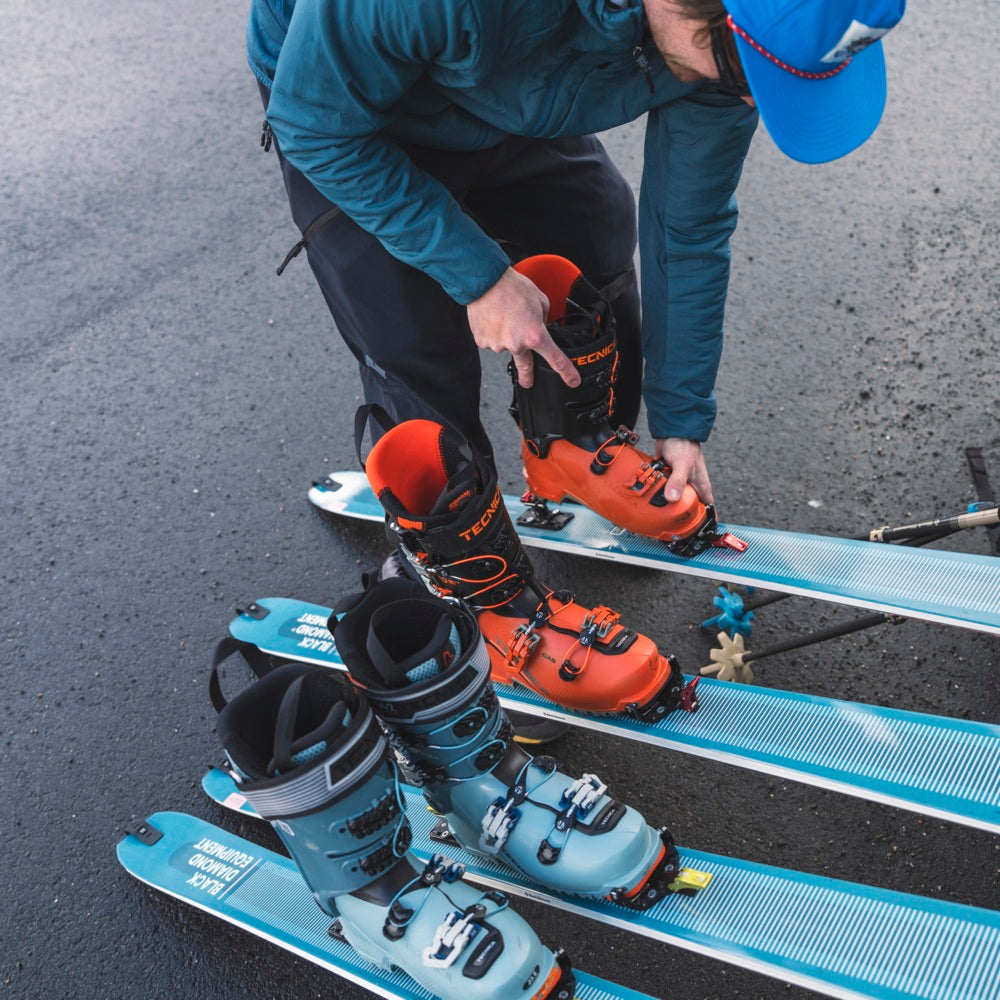
Ski touring boots differ from alpine resort boots in three fundamental ways: a walk mode that unlocks the cuff for uphill travel, tech-compatible toe and heel inserts for pin bindings, and a lugged rubber sole built for mixed terrain. A regular alpine boot locks the cuff in a fixed forward lean — efficient for carving at a resort, but miserable on a skin track. Pull the walk-mode lever on a touring boot and the cuff releases to move with your ankle, letting you stride naturally uphill instead of fighting the boot with every step.
The lugged sole does two jobs: grip on icy approaches before you click in, and compatibility with GripWalk or ISO 9523 alpine-touring bindings. The tech fittings at the toe and heel — small metal inserts that interface with pin-style touring bindings — are what let the binding's heel piece lift freely during the stride and lock down for the descent. Without those fittings you cannot use a tech binding, and tech bindings are the standard for weight-conscious backcountry skiing in the Rockies. Browse our full alpine touring boot selection to see the current range.
Which ski touring boots do we recommend for the Canadian Rockies in 2026?
The right touring boot comes down to how you actually ski — the split between skinning and descending, how many vertical metres you cover in a day, and whether you ever ski the boot at a resort. Below are the models we fit most often in Canmore, grouped by the type of skiing they suit best.
Ultralight and distance-focused
The Dynafit Blacklight Boot is the lightest serious touring boot in the collection — 1,140 g (2.5 lb) for the men's version, 980 g (2.2 lb) for women's — with a 70° walk-mode ROM and a 101 mm (4.0 in) last. It does not carry a traditional flex rating; the shell is tuned for efficiency over raw stiffness, which makes it the right choice for high-mileage objectives like the Wapta Icefield traverse or Skoki. If you are counting grams and logging 20+ days a season in the backcountry, this is where to start.
All-mountain touring — the widest category
Most backcountry skiers in the Rockies want a boot that climbs well enough for a full-day objective and descends confidently on whatever snow they find up top. The Atomic Backland XTD Carbon 120 (men's, flex 120, 1,380 g / 3.0 lb, 74° ROM) and the Atomic Backland XTD Carbon 115 W (women's, flex 115, 1,290 g / 2.8 lb, 74° ROM) are the boots we point most mid-to-advanced skiers toward. The 74° walk-mode ROM is the widest in the collection — you notice it on long skins — and the 100 mm (3.9 in) last fits a medium-volume foot precisely without the pressure that narrower race-derived shells create on cold days.
The Dynafit Ridge Pro Boot (men's, flex 120, 1,250 g / 2.8 lb, 70° ROM) covers similar terrain with a slightly wider 101 mm (4.0 in) last and a fractionally lighter shell. It is the pick for skiers with a wider forefoot who want performance in both directions without the Backland's narrower fit. The Dynafit Ridge Boot (women's, flex 100, 1,150 g / 2.5 lb, 70° ROM) translates the same efficiency into a lighter women's-specific shell — a strong all-mountain option for skiers who prioritize the skintrack without going full ultralight.
Freeride-capable and resort-compatible
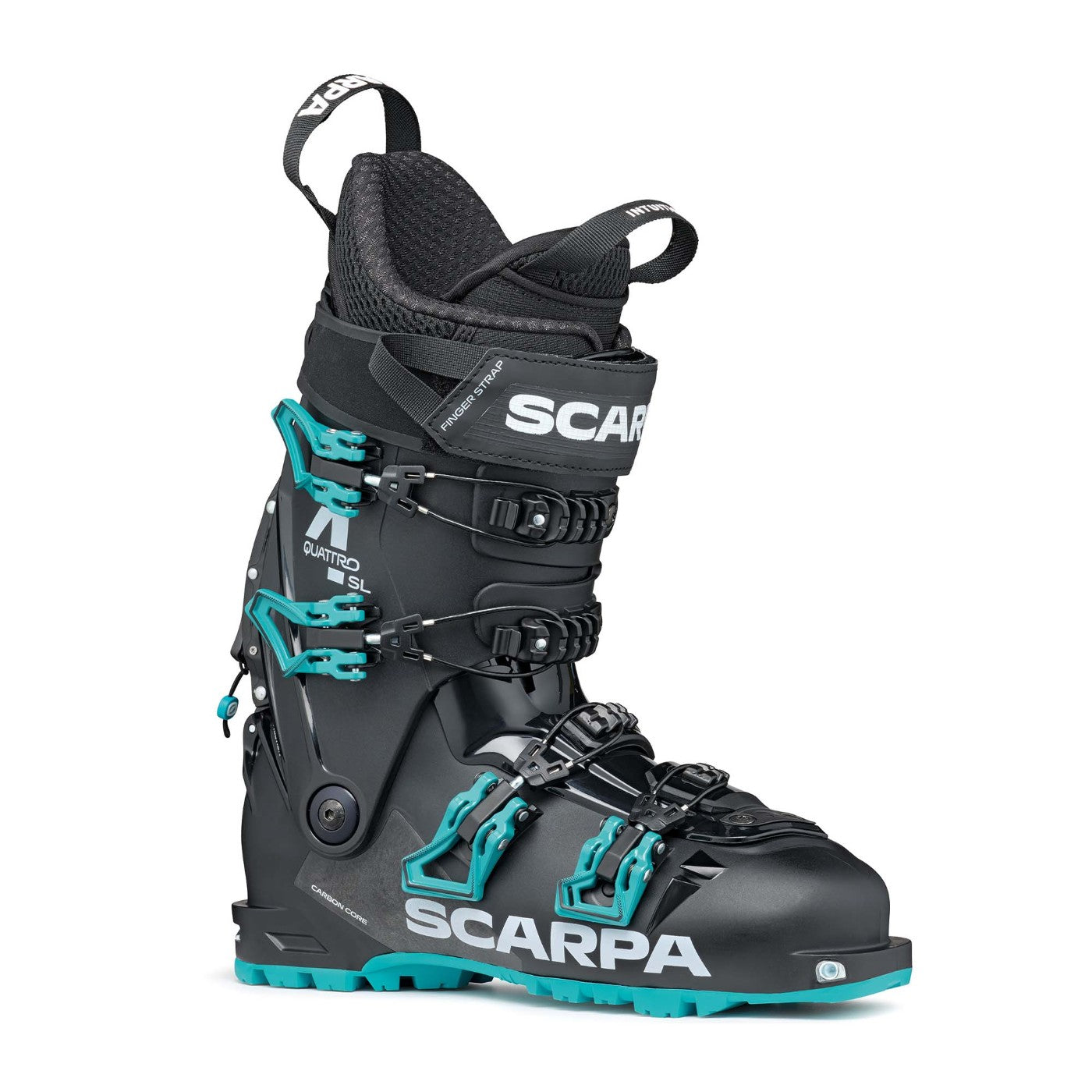
The Dynafit Tigard 130 (unisex, flex 130, 1,590 g / 3.5 lb, 70° ROM) is the highest-flex boot in the collection. It tours — the walk mode works and the GripWalk sole handles approach terrain — but the priority is descent performance. If you are regularly skiing steep couloirs, big Rockies lines, or spending meaningful time at a resort between touring days, the Tigard 130 will feel more at home than a dedicated touring boot. The Scarpa 4-Quattro GT (men's, flex 110) and Scarpa 4-Quattro SL (flex 120) sit in a similar position: Italian-engineered shells with strong downhill manners and functional walk modes, better suited to skiers who weight the descent heavily in their decision.
For skiers who need extra room — 103.5 mm (4.1 in) last, wide forefoot, historically cold feet in narrow touring shells — the Dynafit Radical Pro (flex 120, 60° ROM) is the widest-fitting boot in the collection. It climbs and descends well; the trade-off is the more modest 60° walk-mode ROM next to the Ridge Pro and Backland.
The table below lays out the full lineup side by side — flex, last, weight, walk-mode range, and price — so you can filter by the spec that drives your decision:
| Boot | Flex | Last (mm) | Weight (per boot) | Walk-mode ROM | Best for | Price range (CAD) |
|---|---|---|---|---|---|---|
| Atomic Backland XTD Carbon 120 | 120 | 100 | 1,380 g | 74° | All-mountain touring, strong descents — Men | $900–$1,100 |
| Atomic Backland XTD Carbon 115 W | 115 | 100 | 1,290 g | 74° | All-mountain touring — Women | $900–$1,100 |
| Dynafit Ridge Pro Boot | 120 | 101 | 1,250 g | 70° | Efficiency-focused touring, high-mileage days — Men | $1,000–$1,100 |
| Dynafit Ridge Boot | 100 | 101 | 1,150 g | 70° | Lighter all-mountain touring — Women | $900–$1,000 |
| Dynafit Blacklight Boot | Ultralight | 101 | 1,140 g (W: 980 g) | 70° | Distance objectives, ski mountaineering — Unisex | $950–$1,050 |
| Dynafit Tigard 130 | 130 | 101 | 1,590 g | 70° | Freeride-touring, descent-first skiers — Unisex | $850–$950 |
| Scarpa 4-Quattro GT | 110 | 101 | 1,650 g/pair | — | Resort-capable touring, hybrid skiers — Men/Women | $800–$900 |
| Scarpa 4-Quattro SL | 120 | — | 1,430 g | — | Performance touring with downhill authority — Men/Women | $950–$1,000 |
| Dynafit Radical Pro | 120 | 103.5 | 1,380 g | 60° | Wide-foot skiers, value-conscious buyers — Men/Women | $900–$950 |
Read it by starting with your priority: if it is the climb, track the weight and walk-mode ROM columns (the Blacklight, Ridge Boot, and Ridge Pro lead there); if it is the descent, weight the flex rating and lean toward the Tigard 130 or the Scarpa models; if it is fit, the last column is your filter, with the Radical Pro widest at 103.5 mm (4.1 in).
What flex rating should you look for in backcountry ski boots?
For most Rockies backcountry skiing, a flex between 110 and 120 is the right range — stiff enough to drive a ski confidently in variable snow, but not so stiff that the walk mode becomes the limiting factor on a long ascent. Where this gets complicated is that touring-boot flex ratings are not standardized across brands: a Dynafit 120 and an Atomic 120 feel meaningfully different underfoot. Treat the number as a relative guide within one brand's lineup, not a cross-brand specification.
The most common mistake we see at the counter is prioritizing uphill comfort so heavily that the boot underperforms on the descent. A flex 90–105 boot is genuinely efficient on a skin track, but it will feel vague and overpowered on a sustained steep descent in the Rockies — especially on a hard surface or in variable spring conditions. Unless your objectives are primarily fitness-oriented ski touring or ski mountaineering with moderate descents, stay above flex 110.
At the other end, a flex 130 boot — the Dynafit Tigard 130 and Atomic Hawx Prime XTD 130 both land here — is a resort boot that tours rather than a touring boot that descends well. The walk mode works, and the GripWalk sole handles approach terrain, but you will feel the stiffness on a long skin. That trade-off is worth it if you spend the majority of your days in bounds and only venture into the backcountry occasionally.
How heavy should ski touring boots be for all-day Rockies objectives?
Weight matters more over distance than on a short skin track — on a sustained 1,000 m (3,300 ft) ascent, the difference between a 1,150 g (2.5 lb) boot and a 1,600 g (3.5 lb) boot is felt in the legs, not just on a spec sheet. The practical threshold for most Rockies objectives sits around 1,300–1,400 g (2.9–3.1 lb) per boot. Below that, you are in genuinely efficient touring territory; above 1,500 g (3.3 lb), you are in freeride or hybrid territory, where the boots earn their weight on the descent rather than the climb.
For a Wapta or Bow-Yoho style multi-day objective — sustained skinning over multiple passes, camping, glacier travel — every gram matters, and a boot in the 980–1,250 g (2.2–2.8 lb) range (Blacklight, Ridge Boot, Ridge Pro) leaves noticeably more in your legs for the descents. For a typical Rockies day tour with 600–900 m (1,970–2,950 ft) of vertical and a well-featured ski descent, an all-mountain boot in the 1,250–1,400 g (2.8–3.1 lb) range is a comfortable middle ground. For dedicated freeride skiers adding the occasional tour to reach terrain they cannot lift-access, the extra weight of a 1,500–1,600 g (3.3–3.5 lb) boot is unlikely to be the limiting factor in their day.
The Canadian cold adds one more consideration: heavier boots with more material generally insulate better. The trade-off between a sub-1,100 g (2.4 lb) ultralight shell and warmth on a January day at -20°C (-4°F) in the Rockies is real. If you ski cold conditions regularly — early-season Rockies, high-elevation terrain in February — a mid-weight boot with a quality thermoformable liner often outperforms an ultralight shell on all-day comfort.
Which type of ski touring boot is right for you?
The clearest way to find your category is to be honest about the ratio of skinning to resort skiing in a typical season — and about what the descent looks like at the end of your touring days. A skier logging 20+ days on big Rockies objectives has different needs than a resort skier who tours once or twice a month out the side gate.
Match your profile to the row that fits, then use the flex and last columns as your shortlist filter:
| Skier profile | Typical touring days/season | Priority | Flex range | Last to look at | Boot category |
|---|---|---|---|---|---|
| Fitness tourer / ski mountaineer | 20+ days, long objectives | Uphill efficiency | 90–105 | 99–101 mm | Lightweight touring |
| All-mountain backcountry skier | 10–20 days, mixed terrain | Balance of both directions | 110–120 | 100–102 mm | All-mountain touring |
| Freeride / resort-dominant skier | 5–10 touring days, heavy resort use | Downhill performance | 120–130 | 100–103 mm | Freeride-touring hybrid |
| Sidecountry / occasional tourer | Occasional touring, mostly in-bounds | Resort feel with walk mode | 115–130 | 99–101 mm | Hybrid |
One profile worth naming explicitly: the intermediate backcountry skier transitioning from resort to touring. The most common mistake in this group is buying an ultralight boot before developing the technique to ski it confidently on the descent. A flex 110–120 all-mountain touring boot serves the transition better — you will climb more slowly than someone in a Blacklight, but you will have more confidence and control coming down, and you will progress faster as a result.
Are ski touring boots compatible with regular resort ski bindings?
Most ski touring boots are not directly compatible with standard alpine DIN bindings, but the answer is more nuanced than a flat no — sole type is the variable that decides it. Touring boots with a GripWalk sole (ISO 9523) work with GripWalk-compatible DIN bindings, which are increasingly common on modern alpine setups. The Dynafit Tigard series, Scarpa 4-Quattro models, and Atomic Hawx Prime XTD all carry GripWalk soles and will work with compatible resort bindings.
Touring boots with a pure AT sole — the standard on dedicated touring boots like the Backland XTD Carbon and Dynafit Ridge line — require an AT-compatible binding. Tech bindings (also called pin bindings) are the standard choice here, and they are what we pair with most of the boots in our touring collection. If you are buying boots and bindings together, the pairing is straightforward. If you are adding a touring boot to an existing resort binding setup, bring your binding model to the shop — compatibility varies, and getting it wrong affects both performance and safety. Our guide to alpine touring bindings covers the tech-versus-frame decision in full, and our pin vs. tech binding comparison breaks down the specific trade-offs.
How much should you budget for ski touring boots in Canada?
The best ski touring boots in Canada run roughly $650 to $1,100 CAD, with the all-mountain sweet spot between $850 and $1,050. Below $700, you are typically looking at previous-season clearance stock — still worth considering if the model suits your objectives, but sizing and colour options will be limited. Above $1,000, the premium goes toward lighter materials (carbon-fibre shell components, lighter buckles) and walk-mode refinement rather than a fundamentally different boot experience.
The most common budgeting mistake is under-investing in the liner and the boot-fitting process. A $950 shell with a properly fit thermoformable liner will outperform a $1,100 shell in a stock liner every time — especially in the cold that defines a Rockies winter. Factor professional boot fitting and, where needed, a custom liner upgrade into your total budget. The fitting process in our Canmore shop typically catches fit issues before they become field problems, and it is included with purchase. For the full kit-building picture, our guide to choosing backcountry skis walks through how boots, bindings, and skis fit together.
Frequently asked questions about ski touring boots in Canada
What is the best ski touring boot for a beginner transitioning from resort skiing?
For skiers moving from resort to backcountry, a flex 110–120 all-mountain touring boot is the right starting point — not an ultralight model. Ultralight boots prioritize efficiency on the climb at the expense of downhill support, which makes the descent harder to manage while you are still building touring technique. The Dynafit Tigard 110 or Atomic Hawx Prime XTD are frequently the right call for this profile: they tour well enough for most Rockies objectives and ski confidently enough to keep your progression moving in both directions.
Can I use ski touring boots at a resort?
Yes, with the right binding. Touring boots with a GripWalk sole work with GripWalk-compatible alpine bindings, which are standard on many modern resort setups. Boots with a pure AT sole need a tech binding or a frame AT binding — check with your ski shop before assuming compatibility. In practice, most all-mountain and freeride-touring boots perform well at a resort; ultralight ski-mountaineering boots are less comfortable in bounds and not ideal for resort use.
How do I know if ski touring boots fit correctly?
Use the shell-check test: remove the liner, slide your foot barefoot to the toe of the shell, and check the gap behind your heel. For touring boots, 10–15 mm (0.4–0.6 in) is the target — enough to account for the liner's thickness without creating excess movement. With the liner in, your toes should lightly touch the front when you stand upright and pull back slightly when you flex forward. Pressure points at the ankle bones or fifth metatarsal are a sizing or shell-shape issue, not something that resolves with break-in time.
Do I need tech bindings with ski touring boots?
If your touring boots have tech inserts (toe and heel fittings for pin bindings), a tech binding is the standard and recommended pairing for backcountry skiing. Tech bindings are lighter than frame bindings, release more reliably in touring conditions, and let the heel lift freely during the stride. Frame bindings work with touring boots but add weight and limit stride efficiency. Our ski touring kit essentials guide covers what else belongs in your backcountry setup once boots and bindings are sorted.
How long do ski touring boots last?
A well-maintained touring boot from a quality brand — Dynafit, Atomic, Scarpa, Tecnica — typically lasts 150 to 200 ski days before the shell begins to lose meaningful stiffness. Liners compress and pack out faster, usually after 80–120 days of hard use, and replacing the liner is often the right move before replacing the shell. Storage matters: keep boots out of direct heat and UV in the off-season, and buckle them loosely when not in use to prevent cuff deformation over time.
Where to start your ski touring boot search
If you ski a mix of objectives and tour more than you lap the resort, start with a flex 110–120 all-mountain boot on a 100–101 mm (3.9–4.0 in) last — it is the category that fits the most Rockies skiers without compromising either direction. Step lighter (the Blacklight or Ridge Boot) only if you are logging big-mileage, distance-focused days; step stiffer (the Tigard 130 or a Scarpa 4-Quattro) only if the descent and resort time dominate your season.
Au Canada, la meilleure période pour acheter vos bottes de ski s’étend de septembre à novembre— pendant que l'inventaire est à son maximum, que la ruée du début de saison n'a pas encore réduit le choix de pointures et que la demande du début de l’hiver ne place les modèles populaires sur liste d’attente.
The best time to buy in Canada is September through November — when inventory is full, before the pre-season rush narrows sizing and before early-winter demand pushes the popular models to waiting lists. Getting fitted now means your boots are broken in and ready for the November opener. If you are in Canmore, come in for a fitting: the process takes about 45 minutes, covers shell fit, last width, liner selection, and binding compatibility, and it is included with purchase.
Before purchasing, confirm:
- Your last width against your measured foot — a 100 mm shell and a 103.5 mm shell fit very different feet, and last is the spec that resolves or creates pressure points.
- Binding compatibility — match your boot's sole (pure AT vs. GripWalk/ISO 9523) to your binding, and bring your binding model in if you are pairing with an existing setup.
- Your real objective ratio — how many touring days versus resort days you actually ski in a season, which decides the flex and weight you should be shopping.
- Liner and fit budget — leave room for a thermoformable liner and professional fitting, which matter more for warmth and comfort than the last $150 of shell price.
To shop and compare:
- Ski touring boots — the full AT boot selection at Vertical Addiction in Canmore.
- Alpine touring bindings — tech and frame bindings to pair with your boot selection.
- Climbing skins — skins and accessories to complete your skintrack setup.
- Ski and telemark boots — the broader boot range, including alpine resort and telemark options.
- All ski bindings — the complete binding selection across alpine, AT, and telemark.
For the decisions that pair with your boots, see our alpine touring bindings guide and our guide to choosing backcountry skis.