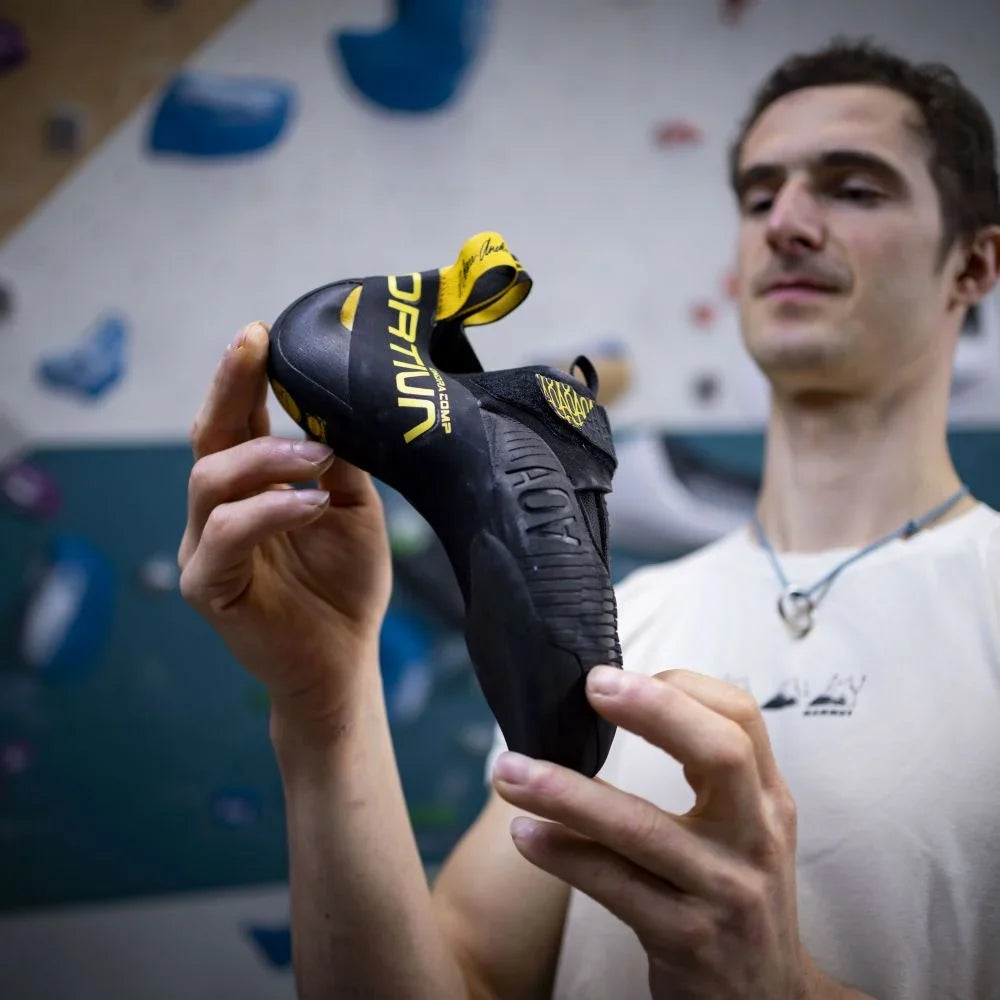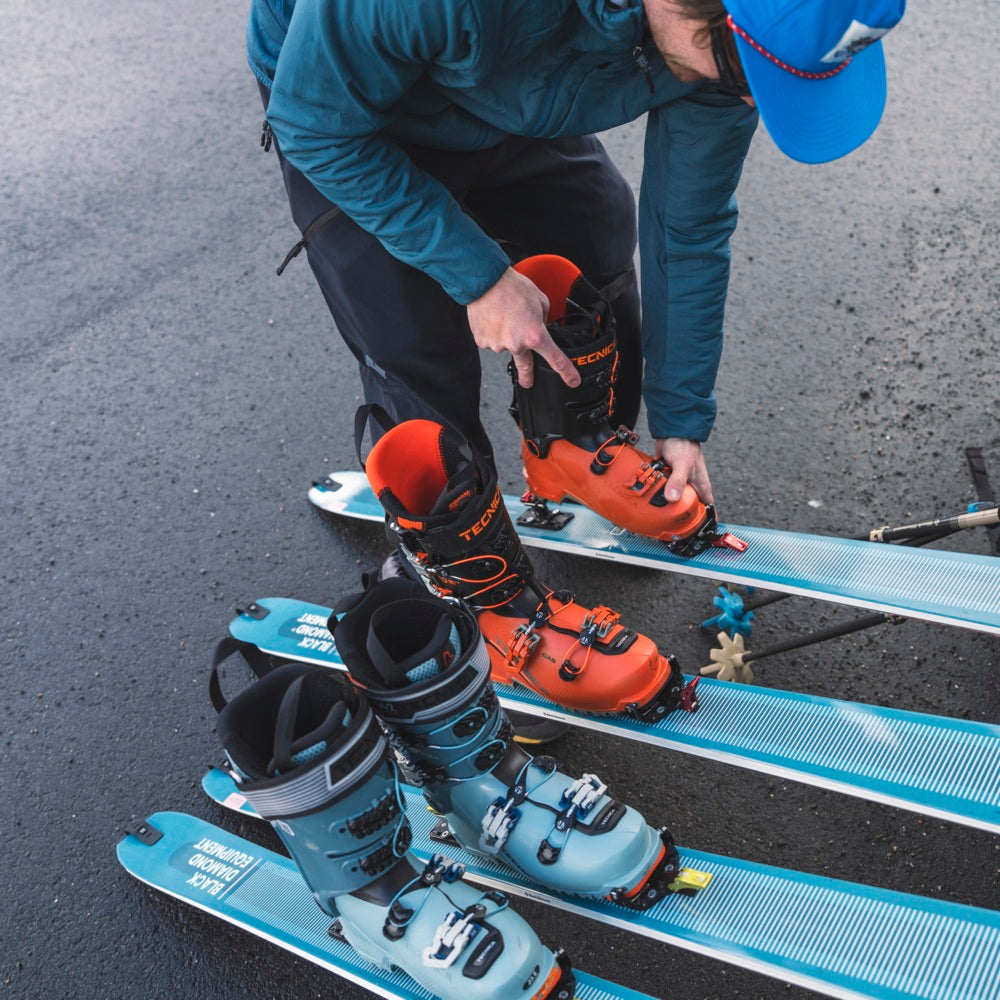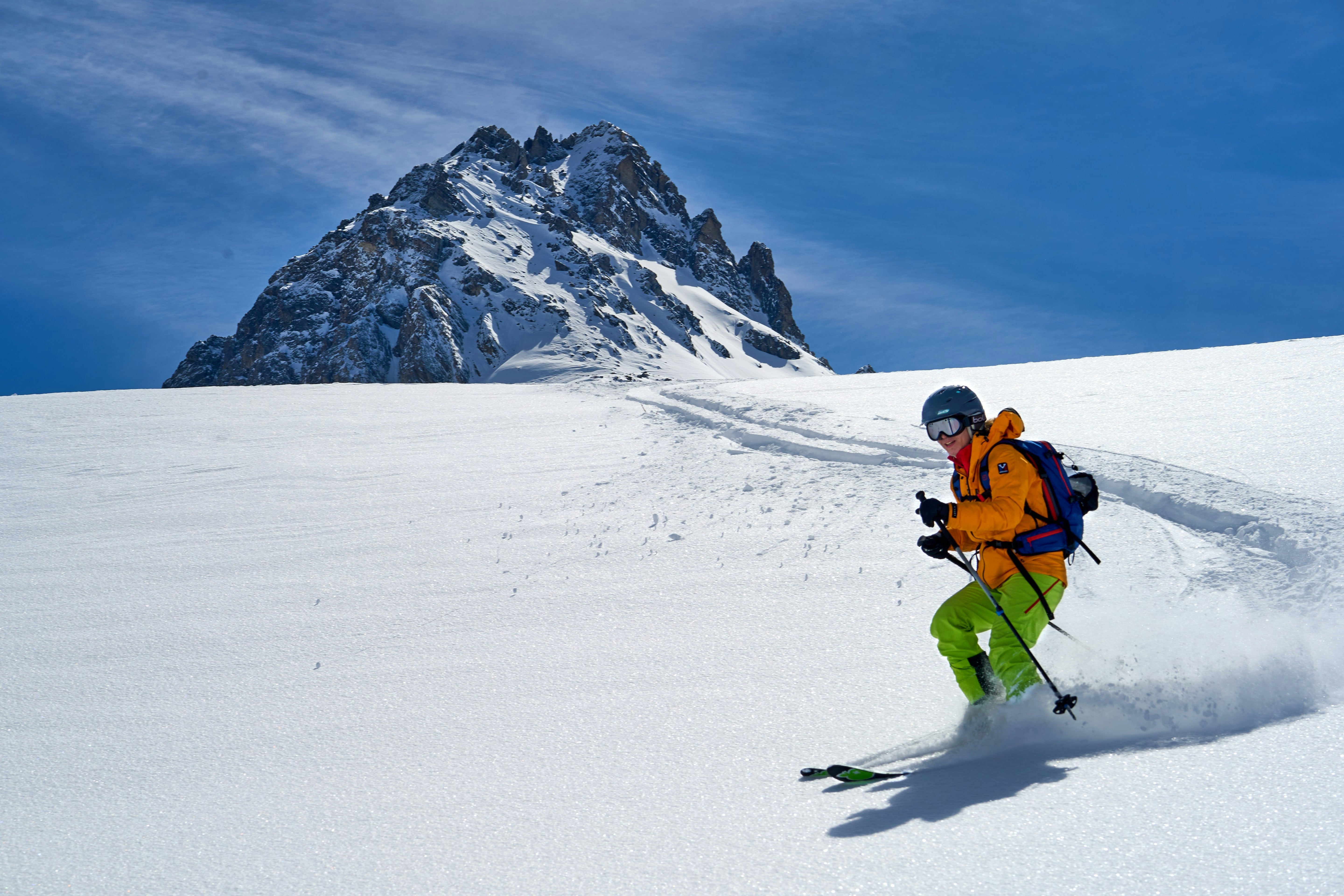
La différence entre les chaussures de ski de randonnée et les chaussures de ski alpin se résume à une seule caractéristique : un mode marche qui déverrouille le collier pour la montée. Les chaussures de randonnée en sont équipées, les chaussures de ski alpin non. Mais le choix n'est pas binaire. Une troisième catégorie – la chaussure hybride – se situe entre les deux, et pour plus de skieurs des Rocheuses que n'importe quelle autre option, c'est la bonne réponse. Ce guide décompose les trois catégories – leurs différences en termes de semelle, de compatibilité avec les fixations, de poids et de mode marche, et laquelle correspond le mieux à votre façon de skier – afin que vous puissiez acheter une fois plutôt que deux. Parcourez la sélection complète de chaussures de ski de randonnée pendant votre lecture, ou commencez par les catégories ci-dessous.
Quelle est la différence entre les chaussures de ski de randonnée et les chaussures de ski alpin ?
Les chaussures de ski alpin sont conçues pour une seule tâche – descendre une piste – avec un collier rigide et fixe et une semelle plate qui se verrouille dans les fixations de station. Les chaussures de ski de randonnée ajoutent un mode marche, une semelle crantée et des inserts pour que vous puissiez monter par vos propres moyens avant de descendre. Tout le reste de la conception des deux chaussures découle de cette distinction fondamentale.
Le collier d'une chaussure alpine est bloqué en permanence en inclinaison avant. C'est exactement ce que vous voulez lorsque vous carve sur les pistes damées de Lake Louise : chaque mouvement de votre jambe inférieure est directement transféré au ski. Mais ce même collier bloqué rend la marche – et encore moins la montée – difficile et épuisante. Le mode marche d'une chaussure de randonnée libère le collier pour que votre cheville puisse fléchir naturellement sur toute son amplitude de mouvement à la montée, puis se verrouille pour la descente. Les chaussures de randonnée sont également dotées d'une semelle en caoutchouc profilée et crantée pour une meilleure adhérence sur les approches verglacées, ainsi que d'inserts à l'avant et au talon qui s'interfacent avec les fixations à broches. Les chaussures alpines ont une semelle plate ISO 5355 conçue uniquement pour s'encliqueter dans une fixation de station.
Le tableau ci-dessous compare les trois catégories en fonction des caractéristiques qui les distinguent réellement :
| Caractéristique | Chaussure de ski alpin | Chaussure de ski de randonnée | Hybride |
|---|---|---|---|
| Mode marche | Non | Oui — le collier se déverrouille pour la montée | Oui — présent, souvent avec une amplitude limitée |
| Type de semelle | Alpine ISO 5355 (plate) | GripWalk ou ISO 9523 (crantée, rocker) | GripWalk (crantée, souvent compatible DIN) |
| Compatibilité fixation | Fixations alpines DIN standard | Fixations tech (à inserts) ; certaines fixations à cadre GripWalk | Souvent fixations alpines et AT |
| Poids typique par chaussure | 1 600–2 200 g (3.5–4.9 lb) | 900–1 600 g (2.0–3.5 lb) | 1 400–1 800 g (3.1–4.0 lb) |
| Plage de flex (typique) | 80–130 | 80–130 | 100–130 |
| Amplitude de mouvement du mode marche | N/A | 60–74° | 40–60° |
| Efficacité en montée | Faible | Bonne à excellente | Modérée |
| Performance en descente | Excellente | Bonne à excellente (flex plus élevé = meilleure) | Excellente |
| Idéal pour | Skieur dédié à la piste | Skieur dédié à l'arrière-pays | Skieur partageant son temps entre station et arrière-pays |
Le schéma des colonnes est cohérent : la chaussure alpine maximise la descente au détriment de la montée, la chaussure de randonnée dédiée maximise la montée avec des descentes suffisamment bonnes, et la chaussure hybride se situe entre les deux avec un penchant pour la descente.
Peut-on utiliser des chaussures de ski alpin pour la randonnée hors-piste ?
La réponse courte est oui, vous pouvez randonner avec des chaussures alpines — mais vous le regretterez après la troisième montée. Un collier bloqué force votre tibia à lutter contre la chaussure à chaque pas en montée, ce qui brûle rapidement de l'énergie et rend l'ascension considérablement moins efficace. Pour une courte approche vers une porte latérale, c'est tolérable. Pour une vraie journée dans les Rocheuses canadiennes — avec une dénivelée soutenue — c'est le mauvais outil.
Il existe également une limite de compatibilité stricte. Les chaussures alpines standard ont une semelle plate ISO 5355 sans inserts techniques, elles ne peuvent donc pas être utilisées avec des fixations tech (à broches) — la norme légère pour la randonnée hors-piste. Vous seriez contraint d'utiliser une fixation à cadre lourde au mieux, ce qui aggraverait le surpoids que vous payez déjà avec une chaussure non destinée à la randonnée. La combinaison d'un collier fixe et d'une fixation à cadre est exactement le type d'équipement dont la plupart des skieurs de randonnée s'éloignent une fois qu'ils parcourent de réelles distances. Si vous prévoyez de randonner régulièrement, une chaussure de randonnée spécialement conçue ou une chaussure hybride sera rentabilisée en énergie économisée au cours d'une seule saison.

Qu'est-ce qu'une chaussure de randonnée hybride, et à qui est-elle destinée ?
Une chaussure hybride est une chaussure de randonnée conçue pour skier comme une chaussure de station : plus rigide, plus lourde et davantage axée sur la descente qu'un modèle de randonnée dédié, avec un mode marche fonctionnel mais qui sacrifie une certaine amplitude de mouvement au profit des performances en descente. Ce n'est pas un compromis qui fait mal les deux tâches. C'est une catégorie distincte conçue pour un skieur spécifique : celui qui passe la plupart de ses journées en station mais qui souhaite une réelle capacité de hors-piste sans posséder deux équipements distincts.
La caractéristique principale d'une chaussure hybride est une semelle GripWalk souvent compatible à la fois avec les fixations AT et les fixations alpines DIN équipées de GripWalk. Cette double compatibilité est tout l'intérêt – une seule paire de chaussures couvre une journée en station le dimanche et une randonnée d'approche à Kananaskis le mercredi. La Dynafit Tigard 110 en est un exemple clair : une chaussure de 110 de flex avec une semelle GripWalk et un mode marche fonctionnel, pesant environ 1 600 g (3.5 lb) par chaussure. Elle est plus lourde qu'une chaussure de randonnée dédiée comme la Dynafit Ridge Pro, mais elle skie comme une chaussure de station à la descente. L'Atomic Hawx Prime XTD 130 BOA se situe encore plus vers le côté station – une chaussure de 130 de flex, 100 mm (3.9 in) de largeur avec fermeture BOA, où le mode marche est plus une fonction de commodité qu'un outil de randonnée. Celle-ci est mieux comprise comme une chaussure de station avec une semelle de randonnée, et non une chaussure de randonnée.
L'erreur la plus courante que nous voyons en magasin est un skieur majoritairement en station qui se persuade d'acheter une chaussure de randonnée ultralégère parce qu'elle a l'air plus «sérieuse» pour l'arrière-pays. Si vous skiez en station trois jours pour chaque jour de randonnée, cette chaussure ultralégère semblera floue et sous-puissante à chaque descente en station – la majorité de votre ski. Une hybride est la réponse honnête pour ce skieur.
Les chaussures de ski de randonnée sont-elles compatibles avec les fixations de ski classiques ?
La compatibilité dépend du type de semelle, et non du nom de la catégorie de la chaussure. Une chaussure de randonnée avec une semelle GripWalk fonctionne avec des fixations alpines DIN compatibles GripWalk, courantes sur les équipements de station modernes. Une chaussure de randonnée avec une semelle AT pure (ISO 9523) nécessite une fixation tech ou une fixation compatible AT — elle ne fonctionnera pas en toute sécurité dans une fixation alpine standard.
C'est le point le plus important à confirmer avant d'acheter des chaussures et des fixations séparément. Si vous assemblez un équipement de zéro, assortissez-les en même temps et le problème disparaît. Si vous ajoutez une chaussure de randonnée à des fixations que vous possédez déjà, apportez le modèle de fixation au magasin avant de vous engager — une erreur à ce niveau affecte le comportement de déclenchement et la sécurité, pas seulement la performance. Notre guide des fixations de ski de randonnée explique en détail la décision entre fixations tech et à cadre, et la comparaison des fixations à broches et tech couvre les compromis spécifiques une fois que vous avez affiné votre choix. Vous pouvez parcourir la sélection complète de fixations de ski de randonnée pour voir ce qui s'accorde avec chaque type de semelle.
Quelle chaussure vous convient le mieux ?
La meilleure façon de choisir est d'être honnête quant à votre ratio station/randonnée et à l'aspect de la descente à la fin de vos journées de randonnée. Un skieur qui fait 90 % de station et des incursions occasionnelles en hors-piste a besoin de quelque chose de fondamentalement différent d'un skieur qui poursuit des objectifs de plusieurs jours sur le champ de glace de la Wapta. Faites correspondre vos habitudes réelles – et non vos aspirations – aux catégories ci-dessous.
| Votre situation | Chaussure à acheter | Pourquoi |
|---|---|---|
| 90%+ station, randonnée occasionnelle par les portes latérales | Randonnée hybride | Performances complètes en station avec un mode marche pour plus de commodité ; une seule chaussure, un seul équipement de fixation |
| Environ 50/50 station et arrière-pays | Hybride ou chaussure de randonnée all-mountain (flex 110–120) | Équilibre entre efficacité et puissance ; compatible GripWalk avec certains systèmes DIN |
| Principalement arrière-pays, journée occasionnelle en station | Chaussure de randonnée all-mountain (flex 110–120) | Meilleure efficacité en montée qu'une hybride ; skie toujours bien en station |
| Objectifs alpins de plusieurs jours, ski-alpinisme | Chaussure de randonnée légère (flex 90–110, < 1 300 g / 2.9 lb) | Le poids est important sur la distance ; les performances en descente sont secondaires |
| Randonnée purement axée sur la forme physique / skimo | Chaussure de randonnée ultralégère | Catégorie axée sur la chasse aux grammes ; non conçue pour les grandes descentes des Rocheuses |
Le fil conducteur : plus votre saison est axée sur la station, plus vous voulez une chaussure performante sous le pied à la descente ; plus elle est axée sur la distance, plus vous apprécierez une coque légère à la montée. Un autre élément à prendre en compte : le reste de votre équipement découle de la chaussure. Une fois que vous avez choisi une catégorie, le choix de votre fixation est dicté par la semelle, et le choix de vos skis doit correspondre aux mêmes objectifs. Si vous construisez un équipement de ski de randonnée à partir des chaussures, le kit de réparation essentiel pour le ski de randonnée couvre le petit matériel qui complète une journée de randonnée, et si vous choisissez toujours des chaussures alpines pour le côté station de votre ski, notre guide pour choisir les bonnes chaussures de ski couvre l'ajustement et le flex pour le contexte de la descente uniquement.
Qu'est-ce qui est le mieux pour les Rocheuses canadiennes — chaussures de randonnée ou chaussures alpines ?
Pour le hors-piste dans les Rocheuses, une chaussure de randonnée ou hybride gagne haut la main ; pour le ski en station dans les Rocheuses, une chaussure alpine ou hybride est le choix. Le facteur décisif est le terrain auquel vous accédez réellement. Dans une station avec remontées mécaniques comme Sunshine ou Lake Louise, vous ne remarquerez jamais l'absence d'un mode marche — et le collier bloqué d'une chaussure alpine vous récompense à chaque descente damée. Une fois que vous montez le Bow-Yoho ou que vous vous approchez d'une ligne à Kananaskis, la différence entre une chaussure de randonnée et une chaussure alpine est la différence entre une journée agréable et une corvée.
Le froid canadien ajoute un élément supplémentaire à prendre en compte. Les chaussures de randonnée plus légères utilisent moins de matériel, ce qui peut signifier des pieds plus froids par une journée de janvier à -20°C (-4°F). Une chaussure de randonnée tout-terrain de poids moyen ou une hybride, associée à un chausson thermoformable de qualité, offre souvent une meilleure chaleur toute la journée dans les conditions des Rocheuses qu'une coque ultralégère. C'est pourquoi, pour la majorité des skieurs des Rocheuses qui pratiquent à la fois la station et le hors-piste, l'hybride résout la plupart des problèmes avec un seul achat — assez chaude, assez rigide pour la descente, et capable de randonner quand vous le souhaitez.
Questions fréquemment posées sur les chaussures de ski de randonnée vs alpines
Puis-je faire de la randonnée avec des chaussures de ski alpin ?
Vous le pouvez, mais c'est inefficace et limité. Les chaussures alpines ont un collier fixe sans mode marche, donc chaque pas en montée lutte contre l'inclinaison avant de la chaussure. Elles manquent également d'inserts tech, elles ne peuvent donc pas être utilisées avec des fixations à inserts légères. Pour une approche courte, c'est gérable ; pour toute vraie distance de randonnée dans les Rocheuses, une chaussure de randonnée ou hybride est bien meilleure et rentabilise rapidement l'énergie économisée.
Que signifie le mode marche sur une chaussure de ski ?
Le mode marche est un levier à l'arrière du collier qui, lorsqu'il est relâché, sépare le collier supérieur de la coque inférieure afin que votre cheville puisse fléchir librement pendant que vous grimpez. Rabattez-le et le collier se verrouille dans une inclinaison avant fixe pour la descente. C'est la caractéristique unique qui distingue les chaussures de randonnée et hybrides des chaussures de station alpines pures, et l'amplitude de mouvement qu'elle offre (60 à 74° sur les chaussures de randonnée dédiées) affecte directement l'efficacité de votre montée.
Qu'est-ce qu'une chaussure hybride en ski ?
Une chaussure de randonnée hybride est conçue pour skier comme une chaussure de station — plus rigide et plus lourde qu'un modèle de randonnée dédié, avec un mode marche fonctionnel mais limité et généralement une semelle GripWalk compatible avec les fixations de randonnée et certaines fixations alpines. C'est le bon choix pour les skieurs qui passent la plupart de leur temps en station mais qui veulent une véritable capacité de hors-piste avec une seule paire de chaussures.
Ai-je besoin de fixations différentes pour les chaussures de ski de randonnée ?
Généralement, oui. Les chaussures de randonnée avec une semelle purement AT nécessitent des fixations tech (à inserts) ou des fixations à cadre compatibles AT. Les chaussures de randonnée avec une semelle GripWalk peuvent fonctionner avec des fixations alpines DIN compatibles GripWalk ainsi qu'avec des fixations AT. Le type de semelle de la chaussure — et non l'étiquette de catégorie — détermine la compatibilité, alors confirmez la correspondance avant d'acheter des chaussures et des fixations séparément.
Est-ce que cela vaut la peine d'acheter des chaussures séparées pour la randonnée et le ski en station ?
Pour la plupart des skieurs, non — une hybride couvre suffisamment bien les deux pour que deux configurations soient inutiles. Des chaussures séparées n'ont de sens qu'aux extrêmes : un skieur freeride dédié qui fait rarement de la randonnée et qui veut une puissance de descente maximale, ou un skieur alpiniste sérieux qui veut la chaussure de randonnée la plus légère possible et qui skie aussi en station avec une chaussure alpine rigide. Pour tous les autres, une chaussure hybride est la solution la plus pratique et la plus économique.
Par où commencer
Commencez par être honnête sur votre ratio station-randonnée — cela indique directement la catégorie de votre chaussure. Si vous skiez la station la plupart des jours et faites de la randonnée occasionnellement, penchez-vous d'abord sur une hybride. Si vous êtes axé sur le hors-piste, une chaussure de randonnée tout-terrain dédiée vous servira mieux. Si vous faites de la randonnée à l'extrême en termes de distance ou de descente, les extrémités légères et freeride de la gamme entrent en jeu.
Avant d'acheter, confirmez :
- Votre ratio station-randonnée — faites correspondre vos habitudes réelles, pas vos aspirations, car cela détermine si vous voulez une hybride, une chaussure de randonnée tout-terrain ou une coque légère.
- La compatibilité semelle et fixation — une semelle GripWalk ouvre les fixations alpines équipées GripWalk, tandis qu'une semelle purement AT nécessite une fixation tech ou AT ; apportez votre modèle de fixation si vous l'associez à une configuration existante.
- L'ajustement de la coque et la largeur du last par rapport à la mesure de votre pied — la spécification qui résout ou crée des points de pression, et ce qu'un ajustement détecte avant que cela ne devienne un problème sur le terrain.
- Le chausson et la chaleur pour le froid des Rocheuses — un chausson thermoformable de qualité est souvent plus important pour le confort toute la journée que de rechercher la coque la plus légère.
Si vous êtes à Canmore, venez pour un ajustement — nous ferons correspondre la catégorie de la chaussure à votre façon de skier, confirmerons la compatibilité des fixations, et ajusterons la coque et le chausson. Pour explorer la gamme en ligne :
- Chaussures de ski de randonnée — modèles de randonnée et hybrides pour le hors-piste.
- Fixations de ski de randonnée — fixations tech et à cadre adaptées au type de semelle de votre chaussure.
- Chaussures de ski et de télémark — la sélection complète de chaussures, y compris les options de station alpine.
- Toutes les fixations de ski — la gamme complète de fixations alpines, de randonnée et de télémark.
Pour les décisions qui accompagnent vos chaussures, consultez notre guide des fixations de ski de randonnée et notre comparaison des fixations à inserts vs tech. Vous ne savez pas où vous en êtes ? Apportez votre équipement existant et votre saison typique à l'esprit au magasin, et nous affinerons ensemble avant que vous ne vous engagiez dans une catégorie.