A packable wind and rain jacket for the Canadian Rockies needs to handle unpredictable valley rain, above-treeline gusts, and rapid temperature drops — all while weighing under 350 g and stuffing into its own pocket. On shoulder-season hikes, trail runs, and alpine approach days from May through October, a minimalist shell outperforms a heavy hardshell in nearly every real-world scenario. Browse our men's technical jackets to see the current packable shell selection.
Key takeaways
- Packable shells in the 150–350 g range cover 90% of Canadian Rockies shoulder-season precipitation events without the weight penalty of a technical hardshell.
- Denier (D) rating tells you durability vs. weight: 10–20D face fabrics pack small but tear more easily on scramble terrain; 30–40D is the practical sweet spot for approach hikes and trail running.
- Pit zips and underarm venting are the most valuable feature on a spring hiking jacket — the Rockies' dry, sunny south faces generate more radiant heat than the shell is rated to breathe through.
- DWR maintenance matters more than membrane rating for jackets used in the Rockies' brief, intense rain events — a freshly treated 2.5-layer shell outperforms a neglected 3-layer one.
- Pair a packable shell with a softshell jacket for an all-conditions kit that handles everything from a warm valley approach to an exposed summit ridge.

Why does a lightweight packable shell beat a heavy hardshell for shoulder-season hiking in the Rockies?
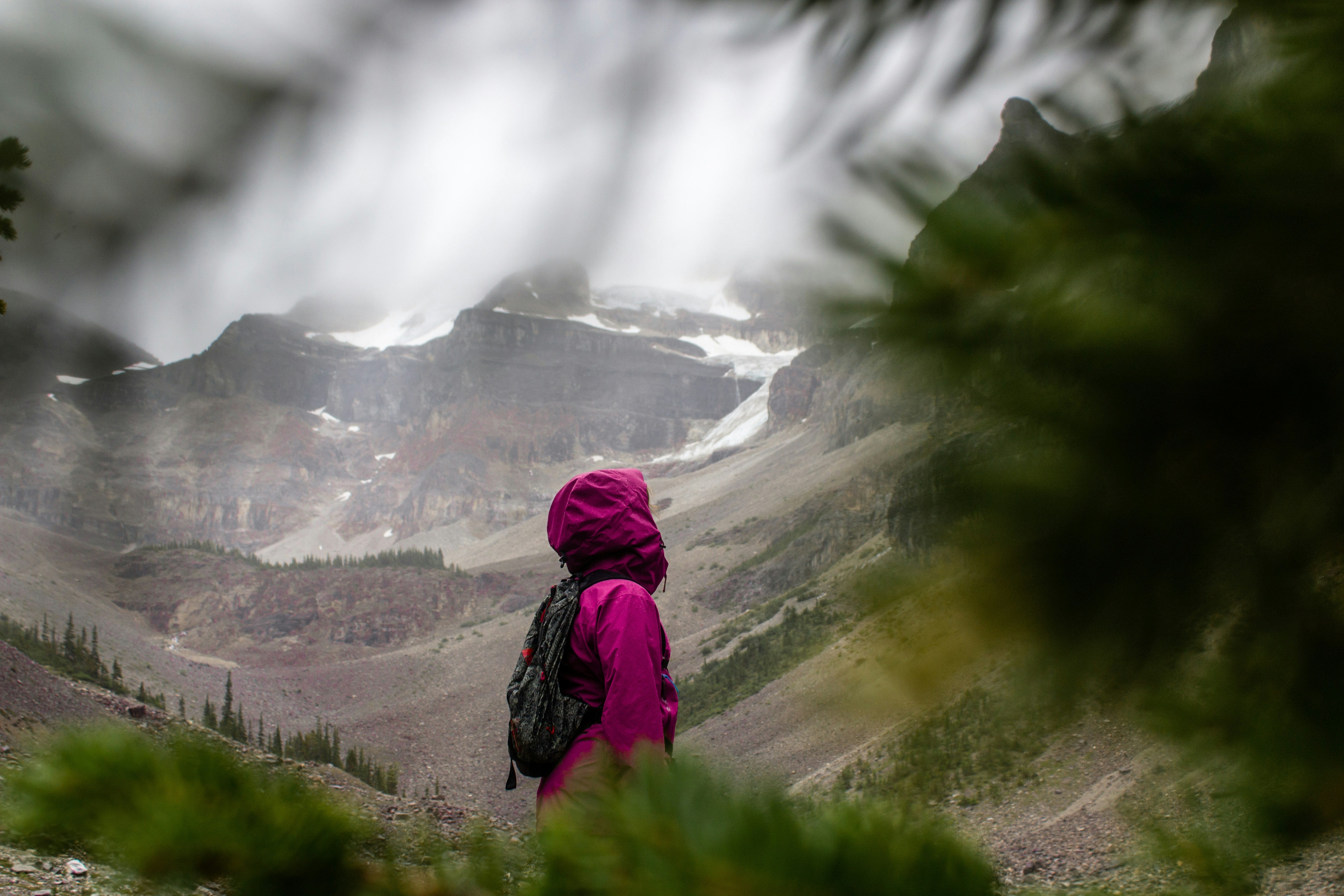
The Canadian Rockies in May, June, and September deliver weather that changes on a 30-minute cycle — warm sun on a south-facing trail, cold wind at the col, brief but intense rain at any elevation. A heavy hardshell jacket (500–700 g) was engineered for sustained alpine precipitation and extended belay stances in wet cold; it's overbuilt for the intermittent conditions that define most shoulder-season hiking days.
A packable wind jacket or lightweight rain jacket in the 150–300 g range solves the actual problem. It lives crammed into the side pocket of a daypack, costs you nothing in fatigue or volume, and goes on instantly when the sky darkens. When the shower passes — typically 15–40 minutes in Rockies valley terrain — it stuffs away just as fast. You spend the day moving comfortably instead of sweating inside a hardshell or stopping to peel it off.
The scenario where the heavy hardshell wins: a multi-day alpine route with sustained precipitation over 4+ hours, ice pitches, or bivouac conditions. For everything below that threshold — day hikes, trail runs, approach days, scrambles on non-technical terrain — a packable shell is the smarter tool.
What does denier rating actually mean for a packable jacket?
Denier (D) measures the thickness and weight of the individual fibres in a fabric — a 10D face fabric is ultralight and compressible, while a 40D fabric is more durable and abrasion-resistant at the cost of slightly more weight and pack volume. For packable jackets used in the Canadian Rockies, the denier of the face fabric determines how the jacket handles trail brush, pack shoulder straps, and rock scramble terrain.
|
Denier range |
Typical weight |
Durability |
Best use case |
|
7–15D (ultralight) |
100–180 g |
Low — tears on sharp rock or snag |
Trail running, fast-and-light day hikes, emergencies |
|
20–30D (lightweight) |
180–280 g |
Moderate — handles trail brush and pack friction |
Day hiking, approach days, shoulder-season scrambles |
|
30–40D (durable light) |
280–380 g |
Good — tolerates pack wear and light scramble contact |
Multi-day hiking, technical approaches, ski touring overgarment |
|
40–75D (standard hardshell) |
350–600 g |
High — daily use over seasons |
Sustained alpine conditions, ice climbing, expedition use |
For most Rockies shoulder-season objectives — Cirque Peak, Ha Ling, Bourgeau Lake, the Skyline Trail, or Johnston Canyon ice-season approaches — a 20–30D packable shell hits the sweet spot between compressibility and durability. The 7–15D ultralight shells are genuinely useful for trail runners and ultralight hikers who accept higher tear risk; for everyone else, they're false economy when a 20D option weighs only 40–60 g more.
What features should I prioritize in a spring hiking jacket for the Canadian Rockies?
The Rockies' shoulder-season conditions impose a specific set of requirements that differ from generic rain jacket specifications — and the features that matter most aren't always the ones manufacturers put on the hang tag. Here's what experienced Rockies hikers and our shop observations point to as the most useful real-world features.
- Pit zips (underarm vents): the single most useful feature on a packable shell for the Rockies. South-facing trail approaches build intense radiant heat that overwhelms the breathability of any membrane — pit zips let you dump that heat without removing the jacket.
- Adjustable hood: a hood that can be cinched flat to the back of the neck when you don't need it and snugged down tight over a hat or helmet when the wind picks up. Rockies ridges see sustained 50–80 km/h gusts during afternoon convective events.
- Stuff-sack packability (to its own pocket): a shell that doesn't stuff into its own pocket adds friction to the on/off cycle and ends up staying on when you're overheating. The best packable shells compress to 400–700 mL.
- Taped seams (at minimum critically taped, ideally fully seam-sealed): the seams are where Rockies rain gets in first. Critically taped seams cover shoulder seams and stitching; fully taped covers every seam. For day hikes, critically taped is usually enough.
- Chest and hand pockets (harness-compatible placement): on scrambling and approach terrain, hip belt pockets are buried under your pack hip belt — chest and upper-arm pockets stay accessible with a full pack on.
- Hem adjustment: a cinchable hem locks out wind-driven rain on gusty ridge terrain and stays comfortable when you need it open for ventilation on warmer approaches.
What is the difference between a wind jacket and a rain jacket — and which do I need?
A wind jacket blocks wind and provides some splash resistance via DWR treatment on an unlaminated face fabric; a rain jacket adds a waterproof-breathable membrane (2.5L or 3L construction) to handle sustained precipitation. The choice for Rockies shoulder-season use is usually a rain jacket, because Rockies precipitation — even in "summer" — comes with cold wind, and the membrane adds only 40–80 g over a wind-only shell.
|
Criterion |
Wind jacket |
Packable rain jacket |
|
Wind protection |
Excellent |
Excellent |
|
Rain protection |
Splash-only (10–20 min max) |
Sustained rain (membrane-rated) |
|
Breathability |
Excellent (no membrane restriction) |
Good to excellent (2.5L/3L varies) |
|
Weight |
80–200 g |
180–350 g |
|
Packed size |
Very small (200–400 mL) |
Small to medium (350–700 mL) |
|
Rockies valley rain (15–40 min bursts) |
Marginal if DWR maintained |
Handles it comfortably |
|
Multi-hour alpine storm |
Not adequate |
Adequate to good (2.5L) / very good (3L) |
The one scenario where a pure wind jacket makes sense as your only shell: trail running where the added weight and bulk of a rain jacket changes your run significantly, you know the forecast well, and you're moving fast enough that body heat manages core temperature even in light rain. For hiking, scrambling, and approach days, the packable rain jacket is the better default.
How do I maintain a packable shell to keep its waterproofing effective?
A packable shell's waterproofing depends almost entirely on its DWR (durable water repellent) treatment remaining functional — when DWR degrades, water doesn't bead off the face fabric but soaks in (called "wetting out"), making the jacket feel cold and heavy even if the membrane underneath is still technically waterproof. The good news: restoring DWR is easy and extends your jacket's performance window dramatically.
- Wash with a technical cleaner: standard detergent residue coats fabric fibres and kills DWR faster than use does. Use Nikwax Tech Wash or a similar tech laundry cleaner every 20-30 days of use.
- Tumble dry on low heat: heat reactivates the DWR treatment bonded to the face fabric. 20 minutes at low heat after washing is the most cost-effective DWR refresh available — it works for 10–15 additional uses before you need a spray treatment.
- Apply spray-on DWR when heat activation stops working: Nikwax TX.Direct spray or a wash-in equivalent adds a fresh DWR layer to the face fabric. Spray-on works better for packable shells (coat coverage is more precise); wash-in works better for insulated pieces with fill that would be affected by the spray.
- Avoid fabric softener and dry cleaning: both destroy DWR permanently and can damage membrane integrity.
The practical DWR maintenance schedule for a shell used 2–3 times per week in Rockies shoulder season: wash with Tech Wash every 2–3 weeks, tumble dry on low after every wash, apply TX.Direct once at the start of season and once mid-season.
Which packable shell is right for trail running vs. hiking vs. approach days?
The right packable jacket weight and denier varies by activity because your movement speed, body heat output, pack configuration, and terrain contact change significantly between trail running, hiking, and technical alpine approaches. Using the wrong tool — a flimsy 10D trail running shell on a rocky approach, or a heavy 40D hiking shell for a fast-and-light trail run — creates problems that better planning avoids.
- Trail running (spring hiking jacket crossover use): prioritize 80–180 g, 10–20D, no pit zips needed (you're moving too fast to overheat), hood that fits over a running hat without flopping, packs to jacket's own pocket. A shell you'll actually wear is worth more than the technically optimal one that stays in your pack because it's annoying to access.
- Day hiking (most Rockies users): prioritize 200–300 g, 20–30D, pit zips or underarm vents, critically or fully taped seams, hood compatible with a sun hat. The men's shell jacket collection has multiple options in this window from Mammut and Ortovox.
- Alpine approach and scrambling: prioritize 280–380 g, 30–40D minimum, harness-compatible pocket placement, helmet-compatible hood, reinforced shoulder zones. You'll be wearing a loaded pack and making rock contact — ultralight fabrics don't survive this terrain over a season.
For hikers who do all three activity types across the season, a single 250–300 g jacket in 25–30D denier is the one-pack-one-shell compromise that serves most days without perfect optimization for any single activity.
Frequently asked questions about packable wind and rain jackets
How waterproof does a jacket need to be for hiking in the Canadian Rockies?
For day hiking in the Rockies, a waterproof rating of 10,000 mm hydrostatic head with a breathability rating of 10,000 g/m²/24h is the practical minimum. Most shoulder-season precipitation events are short and intense (15–45 minutes), not sustained multi-hour soaking rain. A well-maintained 2.5L shell in this range handles the vast majority of Rockies hiking days; step up to a 20,000 mm 3-layer shell only for alpine climbing or multi-day backpacking in high-exposure terrain.
Can a packable rain jacket replace a hardshell for ski touring?
Not as a primary layer in cold ski touring conditions. Packable rain jackets in the 150–300 g range lack the face fabric durability to handle repeated ski boot contact and ski binding clipping, and most aren't insulated enough for chairlift rides or extended stops. They can serve as an emergency layer in a ski pack for unexpected spring storms, but the technical softshell jacket is the correct primary outer layer for ski touring.
What's the lightest packable rain jacket still worth buying for the Rockies?
Jackets below 150 g in 7–10D face fabric are technically impressive but fragile enough that one scramble season in the Rockies typically produces snags, micro-tears, or delamination. The 150–200 g range in 15–20D fabric is the lowest weight that holds up to a full Rockies hiking season with reasonable care. Brands like Black Diamond and Mammut both offer options in this window that are genuinely durable for their weight class.
Is a 2.5-layer shell enough for backpacking in the Rockies in September?
For most September backpacking objectives — the Rockwall Trail, Egypt Lake circuit, or Icefields Parkway routes — a 2.5-layer packable shell is adequate when layered over a fleece or light insulated mid-layer. September in the Rockies brings cool overnight temperatures (0–5 °C) and occasional early snowfall above 2,000 m. Where a 2.5L shell underperforms is in sustained wind-driven precipitation for 4+ hours — if your route includes high-exposure terrain and the forecast is poor, step up to a 3-layer shell with fully taped seams.
How do I know when to wear a softshell vs. a packable rain jacket?
Wear the softshell when you're moving and the precipitation is light (drizzle, wind-driven mist, brief flurries) — its breathability keeps you from overheating. Put the packable rain jacket on over or instead of the softshell when precipitation is sustained, heavier than drizzle, or when you've stopped moving (belay stance, summit rest, camp). The most common mistake is wearing the hardshell or rain jacket from the car — you arrive at the trailhead already wet from sweat instead of rain.

Where to start?
The right packable shell is the piece you actually reach for — lightweight enough to be in your pack on every hike, durable enough to survive a Rockies scramble season, and protective enough to stay on through the brief intense storms that define shoulder-season weather at elevation. Don't underestimate the DWR maintenance piece: a well-maintained 200 g jacket outperforms a neglected 400 g one every time.
Start your search in these collections:
- Men's technical jackets — packable shells, wind jackets, and lightweight rain jackets for day hiking and trail running
- Men's softshell jackets — pair a softshell with your packable shell for the two-piece system that handles every Rockies shoulder-season scenario
- Mammut — technical shells with Rockies-specific features including helmet-compatible hoods and harness-compatible pocket placement
- Black Diamond — packable shells built for the overlap between hiking, climbing approaches, and ski mountaineering
If you're trying to decide between a wind-only shell and a full rain jacket, bring your planned objectives for the season and we can help you narrow the decision based on actual Rockies conditions for those routes and months.